Stockholm Metro Art: A Self-Guided Tour of the Best Stations
A self-guided tour of the Stockholm metro's best art stations: which ones are worth the ride, three routes that link them, tickets, photography rules and the 2026 guided art tours.
Stockholm metro art is the city’s best-value sightseeing: for the price of a public transport ticket you can ride between red-painted caves, rainbow vaults, blue vines and pixel-art clouds, the work of more than 150 artists spread across the 110 kilometres of the tunnelbana. The city likes to call it the world’s longest art exhibition. That is marketing, but it is not far off: almost every one of the 100 stations has something, and a dozen of them are genuinely extraordinary.
This guide is a self-guided tour of the best of them: the stations worth getting off at, line by line, three routes to string them together, what ticket to buy, how to photograph them, and the guided art tours that run in summer. Tour details were checked in October 2026 with Spårvägsmuseet, the transport museum that now runs them. If you want the practical side of the metro, how the lines work, fares and opening hours, that lives in our Stockholm metro guide.
What it is: art in almost all of the metro’s 100 stations, begun in 1957 and still growing.
What it costs: an ordinary SL ticket. A single is valid for 75 minutes; for a proper tour, a 24-hour travelcard is simpler.
Time needed: two to three hours for the best dozen stations, or 45 minutes for the three in the city centre.
Best line: the blue line, whose 1970s stations were blasted out of bare rock and painted like caves.
Guided tours: May to September, by Spårvägsmuseet. In 2026 the English tours ran on the blue line on Thursdays and the red line on Saturdays, both at 15:00, for SEK 150 including museum entry, plus an SL ticket. For future dates and prices, check the Stockholm Transport Museum’s booking site.
Photography: fine for private use without permission, as long as you do not get in the way.
Avoid: weekday rush hours, roughly 07:00–09:00 and 16:00–18:00.
Why the metro is full of art
When Stockholm opened its first underground lines in the 1950s, a group of artists, led by the painters Vera Nilsson and Siri Derkert, pushed the city to put art where everyone would see it, not just gallery-goers. They won, and the first works went into T-Centralen in 1957. Since then almost every new station has been designed with an artist, and older ones have been decorated or redone, so the network is now a timeline of Swedish art from the post-war decades to the present.
The high point came in the 1970s with the blue line. Its stations were blasted deep into the bedrock, and instead of hiding the rock behind tiles, the architects left it raw, sprayed it with concrete and let the artists paint directly onto the cave walls. That is why the most famous stations look the way they do, and why the blue line is where any metro art tour should start.
The best stations, line by line
There are far too many stations to see in a day, and plenty of them are ordinary. These are the ones worth getting off the train for.
Blue line
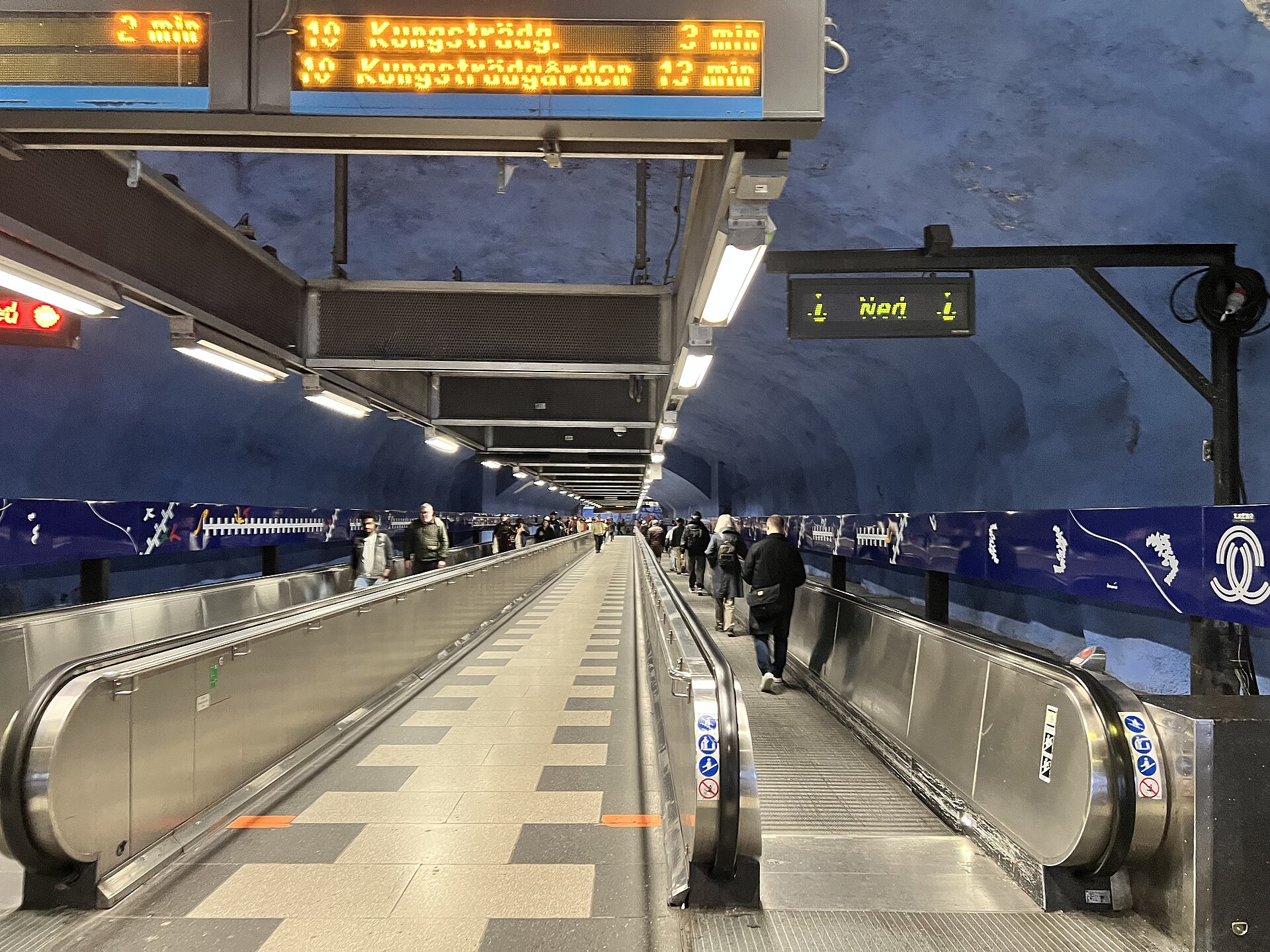
T-Centralen. The blue-line platforms at the main interchange, painted by Per Olof Ultvedt in 1975, are among the best known in the system: deep blue and white vines and leaves climbing over the cave walls and ceiling, with the silhouettes of the workers who built the station painted among them. Most visitors pass through without looking up. Stop and look up at the vault.
Kungsträdgården. The eastern end of the blue line, one stop from T-Centralen, and one of the strangest stations in the system: Ulrik Samuelson turned it into a kind of underground garden and excavation, with sculptures and fragments that nod to the lost Makalös palace that once stood in the park above. It is deep, damp and atmospheric, and nothing like a normal station.
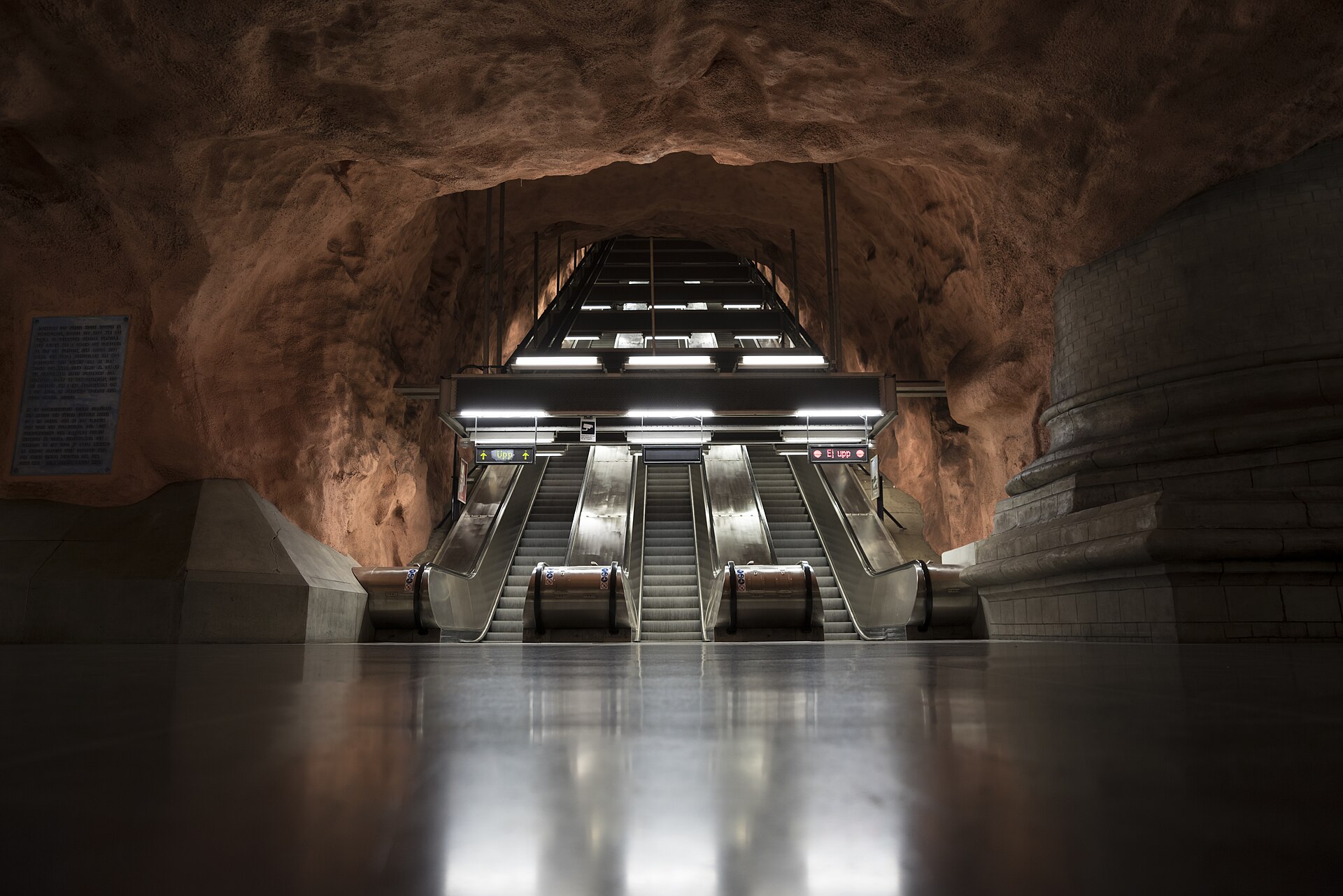
Rådhuset. One stop west of T-Centralen, this station is a cave of bare rock, with the escalators rising out of it like the entrance to a mine. It is under the courthouse, which is what its name means, not the City Hall, which is a ten-minute walk away; our Stockholm City Hall guide has the tour of that building.
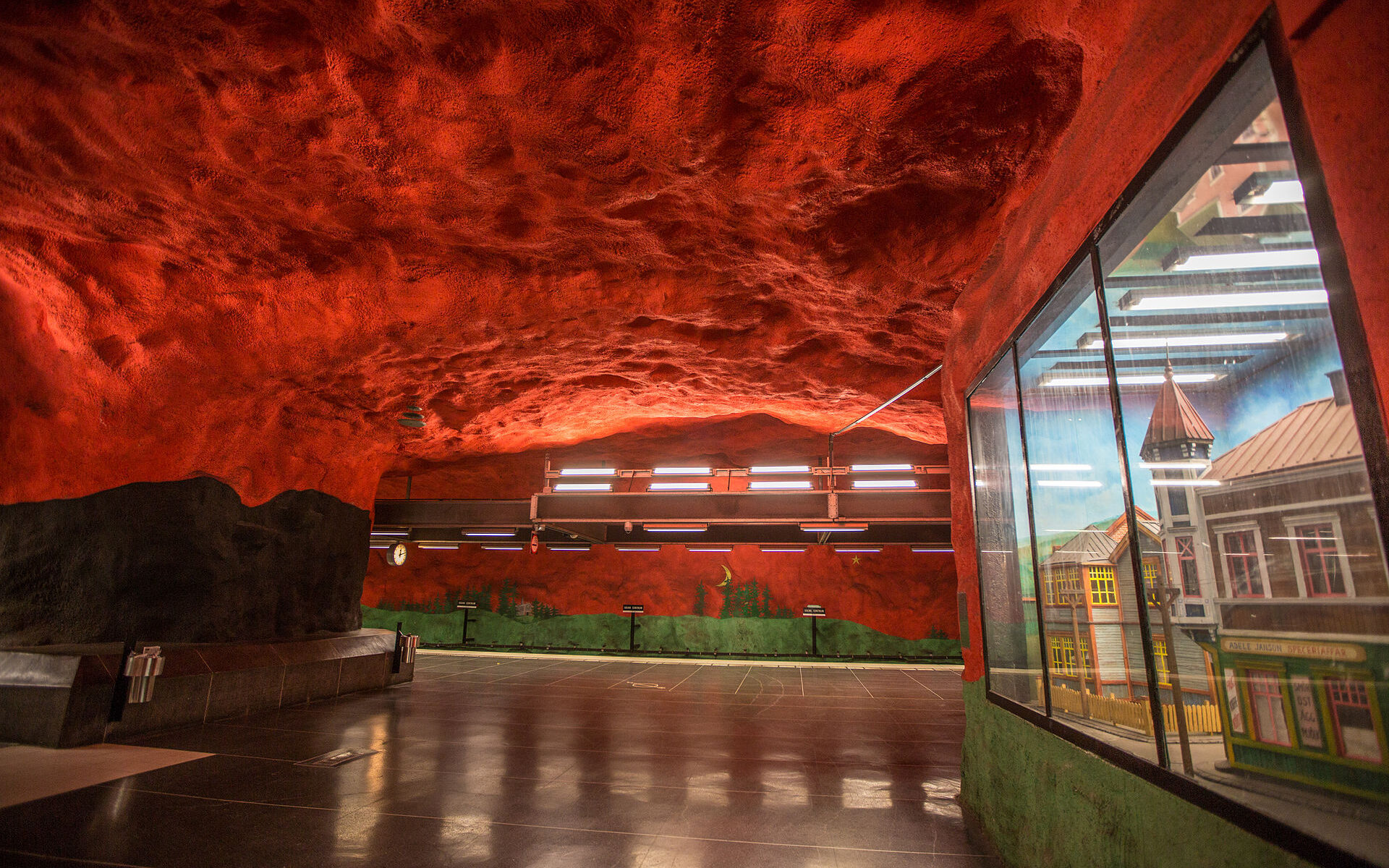
Solna Centrum. The one on the postcards. Anders Åberg and Karl-Olov Björk painted the cave in blazing red and green. The work is a comment on the 1970s debates about the environment and the emptying of the Swedish countryside, and it is breathtaking in person, especially if you catch the platform between trains.
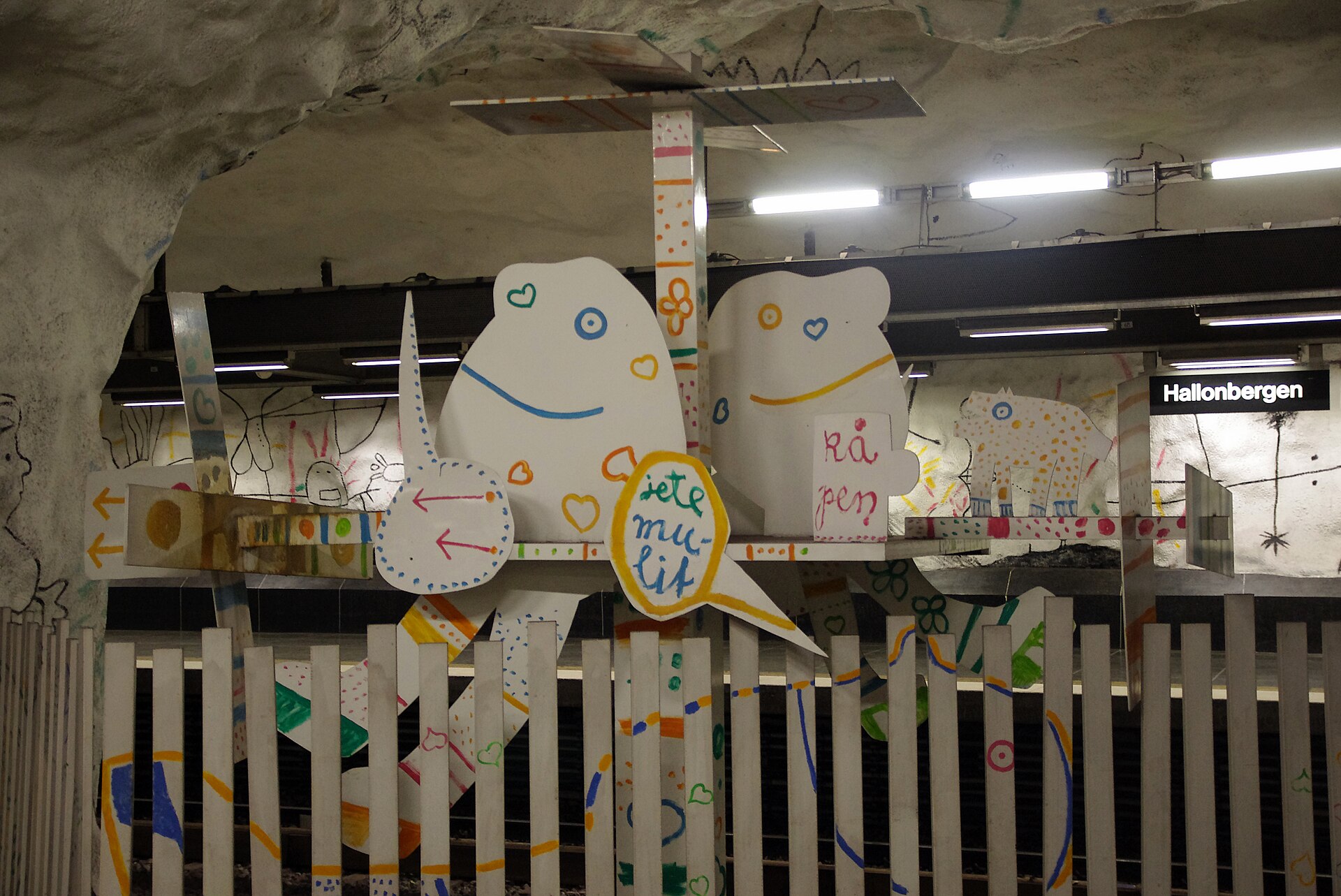
Hallonbergen. Two stops further out, Elis Eriksson and Gösta Wallmark covered the station in art that looks like children’s drawings: cut-out figures, scribbled creatures and words, all in a cheerful naive style. It is the station children love most, and adults tend to leave smiling as well.
Akalla. The end of the line, and worth the ride if you have time: an ochre-coloured grotto with Birgit Ståhl-Nyberg’s ceramic pictures from 1977 showing daily life, work, leisure and the ideals of ordinary people.
Tensta and Solna strand. On the other branch of the blue line, towards Hjulsta. Tensta has Helga Henschen’s colourful paintings across its rock walls, and Solna strand is one of the stations Visit Stockholm picks out for its photogenic design. Both need a change at Västra skogen if you are coming from Solna Centrum, so save them for a second visit or a longer tour.
Red line
Östermalmstorg. The first station in Stockholm to be designed in its entirety by a single artist. In 1965 Siri Derkert covered 145 metres of raw concrete wall with drawings engraved into the surface, addressing women’s lives, peace and environmental issues under the title Ristningar i naturbetong, roughly “engravings in natural concrete”. It is monochrome, subtle and easy to miss, and it is one of the most important works in the whole network.
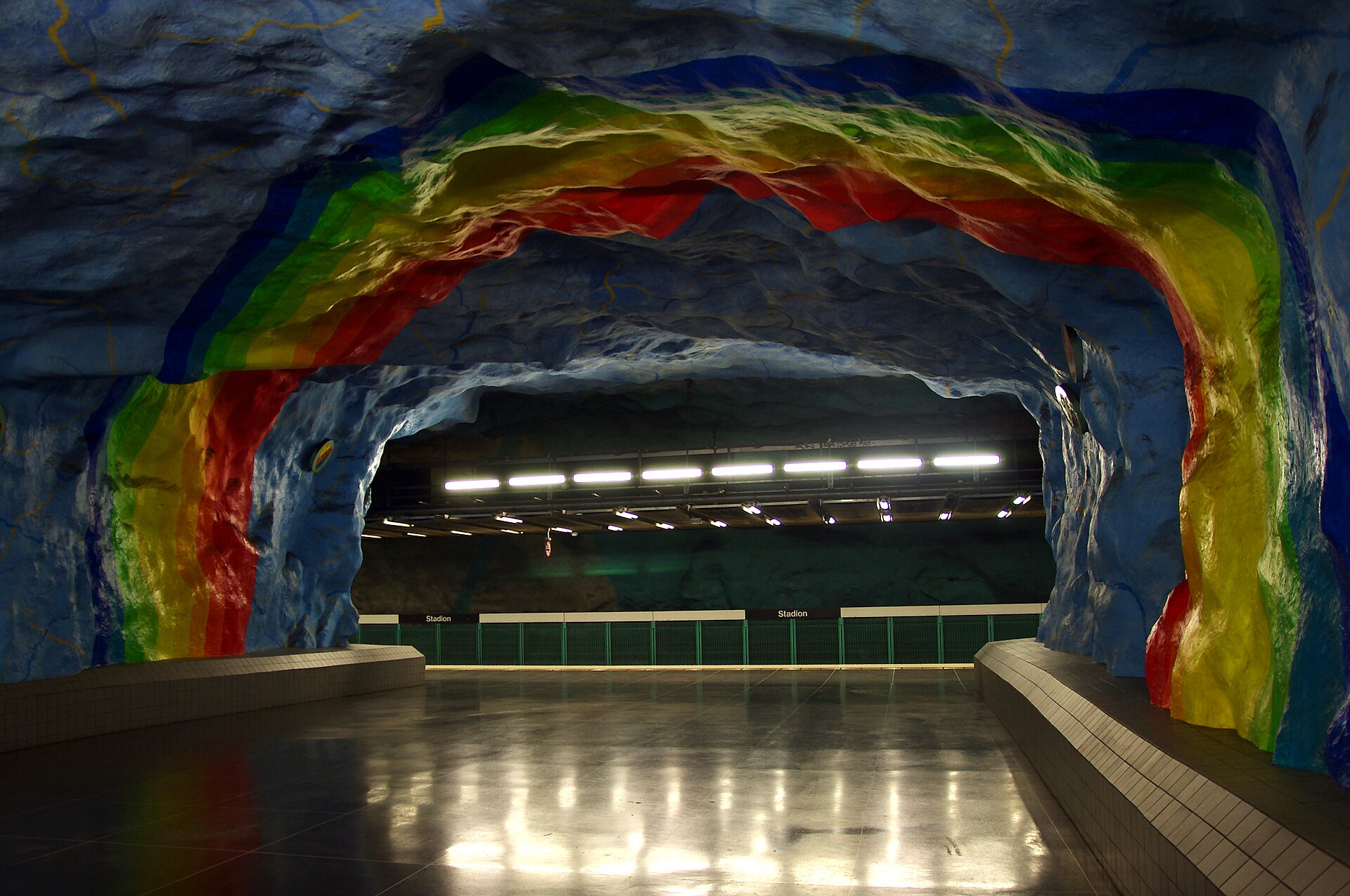
Stadion. Near the stadium of the same name, the station is a cave of blue sky with a huge rainbow arching across it, the work of Åke Pallarp and Enno Hallek. It is the happiest station in Stockholm, and one of the most photographed.
Tekniska högskolan. The station for KTH, the Royal Institute of Technology, where Lennart Mörk’s art takes technology, the four elements and the laws of nature as its themes, with a huge polyhedron hanging in the hall. It is a good station for anyone who likes their art with a bit of science.
Universitetet. The station for Stockholm University, decorated since 1997 by Françoise Schein with ceramic tiles carrying the text of the UN Declaration of Human Rights, alongside images of Carl Linnaeus’s travels. Read a few lines while you wait for your train.
Mörby centrum. At the northern end of the line, another of Visit Stockholm’s photogenic picks, if you want to ride the red line to the end.
Green line
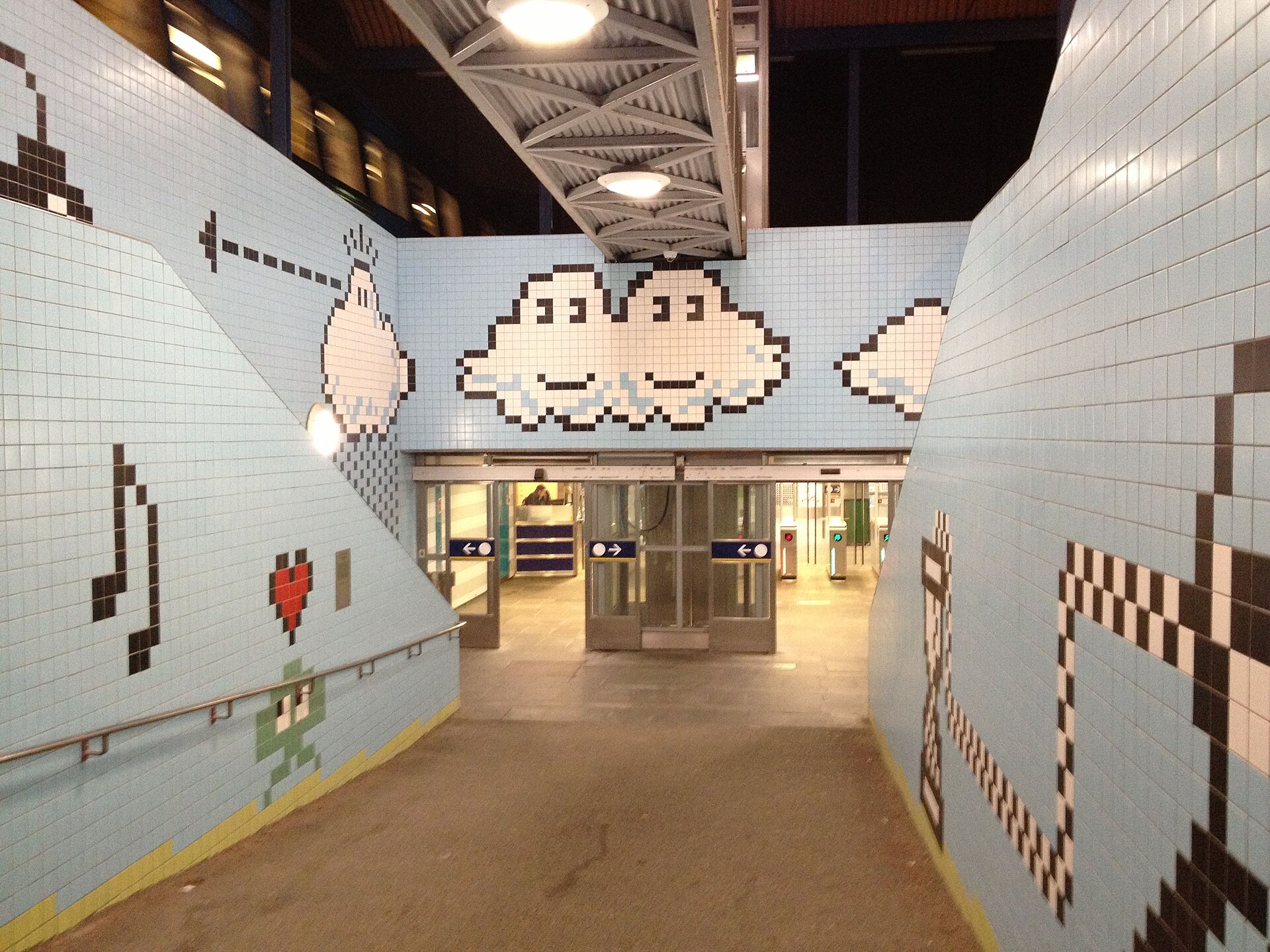
Thorildsplan. The green line is mostly older, simpler stations, but Thorildsplan, west of the centre, is the exception. Lars Arrhenius was commissioned in 2008 to decorate it with tiles, and he turned the station into a scene from a 1980s video game: pixelated clouds, hearts, music notes and little figures in blocky tiles. It is one of the most fun stations to photograph.
Rådmansgatan. A detour for literature lovers. At the southern entrance, Sture V Nilsson’s works are devoted to August Strindberg, who spent his last years a short walk away in the building that is now the Strindberg Museum. The art is outside the ticket barriers, so you can see it without a ticket.
Hötorget and Bagarmossen. Both are on Visit Stockholm’s list of the most photogenic stations, Hötorget in the city centre and Bagarmossen on the southern branch towards Skarpnäck.
Beyond the metro: the new commuter stations
The Citybanan commuter rail tunnel opened in 2017 with two stations, Stockholm City beneath T-Centralen and Odenplan, and Odenplan is on Visit Stockholm’s list of the most photogenic stations in the city. They are on the SL commuter trains rather than the metro, but the same ticket covers them.
| Station | Line | Artist | Look for |
|---|---|---|---|
| T-Centralen | Blue | Per Olof Ultvedt (1975) | Blue vines and the silhouettes of the builders |
| Kungsträdgården | Blue | Ulrik Samuelson | An underground garden and excavation |
| Rådhuset | Blue | Sigvard Olsson | A raw red-brown cave |
| Solna Centrum | Blue | Anders Åberg and Karl-Olov Björk | Red sky over a green forest |
| Hallonbergen | Blue | Elis Eriksson and Gösta Wallmark | Art in the style of children’s drawings |
| Akalla | Blue | Birgit Ståhl-Nyberg (1977) | Ceramic pictures of everyday life |
| Östermalmstorg | Red | Siri Derkert (1965) | Drawings engraved into concrete |
| Stadion | Red | Åke Pallarp and Enno Hallek | A rainbow across a blue vault |
| Tekniska högskolan | Red | Lennart Mörk | Science, the elements and a hanging polyhedron |
| Universitetet | Red | Françoise Schein (1997) | The Declaration of Human Rights on tiles |
| Thorildsplan | Green | Lars Arrhenius | Pixel-art video-game tiles |
| Rådmansgatan | Green | Sture V Nilsson | Strindberg, outside the barriers |
Three self-guided routes
The blue line classic (about two hours)
This is the one to do if you only do one. Start at Kungsträdgården, ride one stop to T-Centralen and go down to the blue-line platforms, then one more stop to Rådhuset. Stay on a train towards Akalla to Solna Centrum, then two stops further to Hallonbergen. If you have the energy, ride to the end at Akalla, then come back the way you came. Every stop is on the same line, so there are no changes, and the trains run often enough that getting off to look costs you only a few minutes each time.
The red line north (about an hour)
From T-Centralen, take a red-line train towards Mörby centrum. Get off at Östermalmstorg for Siri Derkert’s walls, then carry on to Stadion, Tekniska högskolan and Universitetet. From Universitetet it is a short walk to the Bergianska botanic garden, which makes a pleasant end to the tour on a fine day.
The short version (about 45 minutes)
Short of time? Kungsträdgården, T-Centralen and Rådhuset are consecutive stops on the blue line in the city centre and give you three of the best stations with almost no travelling. Add Östermalmstorg, one stop from T-Centralen on the red line, if you have another twenty minutes.
For extras, Thorildsplan is six stops west of T-Centralen on the green line, and Rådmansgatan is two stops north, near the Strindberg Museum.
Tickets
You need a valid SL ticket to go through the barriers, as for any metro journey; there is no special art ticket. A single ticket is valid for 75 minutes, which is enough for the short version but not for a proper tour, so for anything longer a 24-hour travelcard is simpler and covers the rest of your day’s travel as well. Buy tickets in the SL app, at the ticket machines or at the SL customer centre at T-Centralen, and scan your ticket at the gates. Our SL card guide has the current prices and explains which ticket suits your stay.
Guided metro art tours in 2026
If you would like someone to tell you the stories behind the stations, the guided art tours are run by Spårvägsmuseet, Stockholm’s transport museum, from May to September. In 2026 the English-language tours ran on the blue line on Thursdays at 15:00, starting at T-Centralen, and on the red line on Saturdays at 15:00, starting at Östermalmstorg. There was also a Swedish blue-line tour on Thursday evenings.
Tours cost SEK 150, which includes a ticket to the museum itself, and you need a valid SL ticket on top, which is not included. Book through the museum’s website. Older guides and blogs describe free SL art walks leaving from the SL customer centre; in 2026 the tours are run by the museum, so check its programme before you go rather than turning up at T-Centralen expecting a free walk.
Is the tour worth it? If you enjoy art, yes. The guides bring out details you would never notice alone and explain what the artists were arguing about, which matters in stations like Östermalmstorg and Solna Centrum. If you mainly want photographs, the self-guided routes above are cheaper and more flexible.
Photographing the stations
Taking photos and video in SL’s stations and trains for private use needs no permission, as long as you do not affect or disrupt the traffic. That is the key condition: nobody will stop you photographing the rainbow at Stadion, but a tripod set up on a busy platform risks getting in the way, and commercial shoots need SL’s approval. Our guide to photography rules in Stockholm explains the details.
- Go early at weekends. Saturday and Sunday mornings are the quietest time, and the best chance of an empty platform.
- Use a wide lens or your phone’s wide-angle setting. The caves are best shown whole.
- Wait for a train, or for it to leave. A train pulling in adds scale and colour; an empty platform shows the art.
- Look at the floor. The polished floors in stations such as Stadion and Solna Centrum reflect the ceilings beautifully.
- Be considerate. Keep out of the way of people travelling, and do not photograph strangers up close without asking.
For more places with a camera, see our guide to the most photogenic places in Stockholm.
When to go
The metro art is an all-weather, all-year sight, and it is at its most useful on the days when nothing else is. On a wet afternoon or in the dark of January, a few hours riding between warm, dry, brightly painted caves beats almost anything else in the city; our guides to Stockholm when it rains and Stockholm in winter have more ideas for those days. The only times to avoid are the weekday rush hours, roughly 07:00 to 09:00 and 16:00 to 18:00, when the platforms are crowded and nobody wants you standing still.
Accessibility
The metro is only partly accessible. Many stations have lifts, but far from all of them do, and lifts are sometimes out of service, so check lift status in the SL app before you plan a route. The deep blue-line stations have long escalators. SL’s accessibility line, +46 20 120 20 22, is open around the clock for journey advice and free assistance. Our Stockholm accessibility guide covers the rest of the city.
Is the metro art worth your time?
Absolutely, with one caveat. It is one of the best things to do in Stockholm, it costs almost nothing, and the best stations, T-Centralen, Solna Centrum, Stadion, Rådhuset, Kungsträdgården and Östermalmstorg, are genuinely world-class public art. The caveat is the “world’s longest art exhibition” line. It encourages people to try to see everything, and most of the network is ordinary. Pick a route, give it two or three hours, and spend the rest of your day above ground.
It also works best mixed in with other plans. Stadion is next to the Olympic Stadium, Universitetet is close to the Bergianska botanic garden, Rådmansgatan is by the Strindberg Museum, and Kungsträdgården comes out in the middle of the city’s favourite park. For more ideas in the same spirit, see our guides to free things to do in Stockholm and unusual things to do in Stockholm, and for families, museums in Stockholm for kids, where Hallonbergen fits right in.
Frequently asked questions
Which Stockholm metro stations have the best art?
T-Centralen (blue vines), Solna Centrum (red sky over a green forest), Stadion (a rainbow), Kungsträdgården (an underground garden), Rådhuset (a raw rock cave) and Östermalmstorg (Siri Derkert’s engraved walls) are the essentials. Thorildsplan’s pixel art and Hallonbergen’s children’s drawings are the most fun.
How much does it cost to see the metro art?
Only the price of an SL ticket. A single ticket is valid for 75 minutes, which covers a short tour; for a longer one, a 24-hour travelcard is simpler.
How long does a metro art tour take?
About two hours for the blue-line highlights, an hour for the red line north, or 45 minutes for the three city-centre stations: Kungsträdgården, T-Centralen and Rådhuset.
Are there guided tours of the metro art?
Yes, from May to September, run by Spårvägsmuseet. In 2026 the English tours ran on the blue line on Thursdays and the red line on Saturdays, both at 15:00, for SEK 150 including museum entry; you also need an SL ticket.
Which line has the best metro art?
The blue line. Its 1970s stations were blasted out of bare rock and painted directly, which produced famous cave stations such as T-Centralen and Solna Centrum.
Can I take photos in the Stockholm metro?
Yes. Photos and video for private use need no permission as long as you do not disrupt traffic. Commercial shoots need SL’s approval, and a tripod on a busy platform may be asked to move.
How many Stockholm metro stations have art?
Almost all of the 100 stations have some art, across 110 kilometres of track. The programme began in 1957, and new stations are still designed with artists.
Is T-Centralen’s art on the blue line?
Yes. The famous blue vines by Per Olof Ultvedt are on the blue-line platforms. Follow the signs for the blue line (Kungsträdgården, Hjulsta or Akalla) and look up.
More Stockholm guides
- Best Museums in Stockholm: 20 Must-See Attractions: the city’s collections above ground.
- Stockholm Metro Guide: lines, fares and opening hours.
- SL Card Stockholm: which ticket or travelcard to buy.
- Stockholm City Hall: the building Rådhuset station is not named after.
- Moderna Museet: Swedish and international modern art.
- Free Things to Do in Stockholm: the best of the city for nothing.
- Stockholm When It Rains: indoor ideas for grey days.
- Things to Do in Stockholm: the full list.
Photo credits
Solna Centrum station (featured image): Solna Centrum, Stockholm by Tony Webster, CC BY 2.0, via Wikimedia Commons.
T-Centralen passage: Inter-platform passage at T-Centralen by HartOve, CC BY-SA 4.0, via Wikimedia Commons.
Rådhuset station: Rådhuset by Tom Björkstedt, CC BY 2.0, via Wikimedia Commons.
Hallonbergen station: Stockholm Hallonbergen metro station by Jakub Hałun, CC BY-SA 3.0, via Wikimedia Commons.
Stadion station: Stockholm Stadion metro station by Jakub Hałun, CC BY-SA 3.0, via Wikimedia Commons.
Thorildsplan station: Thorildsplan by Stanpol, CC BY-SA 3.0, via Wikimedia Commons.