Stockholm Nightlife Areas: Where to Go Out
Stockholm's going-out life happens in squares, not districts. Hornstull, SoFo, Medborgarplatsen, Brunkebergstorg and Stureplan compared on price, crowd, closing time and which night of the week each one works.
The honest answer to where to go out Stockholm is not a neighbourhood — it is a square. This city’s going-out life organises itself around half a dozen small areas, each one a five-minute radius of bars, each with its own crowd, price level and closing time, and the difference between a good night and a wasted one is usually picking the right one before you leave the hotel rather than after.
This guide works at that scale: not “Södermalm” but Hornstull, Mariatorget, Medborgarplatsen and SoFo, which are all Södermalm and all completely different. For the broader district-by-district picture — the character of each island, where to stay, how the areas relate — the Stockholm nightlife by neighbourhood guide does that job, and this page assumes you have already decided which half of the city you are in. Prices were checked in September 2026 and are in Swedish kronor.
Best all-round area for a first visit: Hornstull, Södermalm — dense, walkable, no door problems.
Best for a young crowd and cheap rounds: Medborgarplatsen.
Best for a serious drink: Brunkebergstorg, Norrmalm.
Best for dressing up: Stureplan — and only if that is genuinely what you want.
Areas to avoid right now: Slussen, still a building site until 2027.
Typical spend: SEK 70–100 a beer, SEK 145–195 a cocktail, SEK 100–200 club entry.
Getting home: metro runs all night Friday and Saturday; night buses the rest of the week.
How to choose an area in ninety seconds
Before the detail, the shortcut. Answer three questions and the map narrows to one or two places.
| If you want… | Go to | Skip |
|---|---|---|
| Bars you can walk between, no queue | Hornstull | Stureplan |
| A cheap, loud, young night | Medborgarplatsen | Östermalm |
| Small rooms, good drinks, early | Vasastan, around Odenplan | Gamla Stan |
| Award-level cocktails | Brunkebergstorg | Västerlånggatan |
| Dressing up and a club at 01:00 | Stureplan | Kungsholmen |
| Dinner that turns into drinks | SoFo, east of Götgatan | Norrmalm’s chain strip |
| A quiet local evening | Kungsholmen, Fridhemsplan | Anywhere on a Saturday |
Södermalm: four areas, not one
Söder is where most people are told to go out, and the advice is right but uselessly broad. The island is four kilometres long and its going-out areas have almost nothing in common. The Södermalm guide covers the island by day; this is the evening version.
Hornstull — the safest bet in the city
Western end of the island, red-line metro, and the single best area to send someone who has one night and no strong opinions. Everything is within four streets: Tjoget with its four rooms under one roof, Linje Tio a couple of minutes away for later and louder, and a run of smaller bars and restaurants along Hornsbruksgatan and Långholmsgatan that fill up without ever developing a door policy.
What makes Hornstull work is the ratio. Enough venues that you never have to commit, small enough that you are not walking between them in the rain, and a crowd that skews local and thirty-ish rather than either student or corporate. Prices sit mid-range: SEK 80–95 for a beer, SEK 155–185 for a cocktail.
The waterfront is the other reason to come. In summer the Hornstull side of the island faces west over Mälaren, which means the long Swedish sunset lands directly on it, and the outdoor seating fills from about five o’clock. In winter it is an ordinary, well-lit, perfectly functional bar district.
SoFo — dinner that becomes drinking
The blocks south of Folkungagatan and east of Götgatan — Skånegatan, Bondegatan, Nytorget — are Stockholm’s most enjoyable place to start an evening and its worst place to plan one. SoFo does not really have bars so much as restaurants with good bars attached, which means the natural shape of a night here is eating at eight and drifting until midnight rather than crawling.
Nytorget, the square at the middle, is the anchor. Around it: small kitchens, natural wine, a few places that keep serving late, and essentially no tourists after dark. It is the area locals name when asked where they actually go, and it is also the area where you should book, because the good rooms are small.
Go here if you want an evening rather than a night. Go elsewhere if you want to be out at two.
Medborgarplatsen — young, loud and cheap
Medborgarplatsen is the least fashionable recommendation in this guide and the most useful one for a certain kind of night. The square and the streets feeding it hold a high density of large, straightforward bars, a student-heavy crowd, and the cheapest rounds you will find within reach of the centre — beer from about SEK 65–75 in the less polished places.
Nobody will tell you the drinks are good. They are fine. What Medborgarplatsen has is capacity, which means that on a Friday when every small bar in Vasastan is full and Lucy’s has a queue, there is somewhere here that will take eight people at 22:00 without a booking. That is worth knowing.
It is also the most reliable late-night food area on the island, which matters more at 01:30 than it does now.
Mariatorget — the civilised version
A leafy square with a fountain, a Swedenborg bust, and a ring of quiet bars and restaurants around its edges. Mariatorget is a daytime park that turns into a genial, low-key drinking area in the evening, aimed squarely at people in their thirties and forties who would like to hear each other.
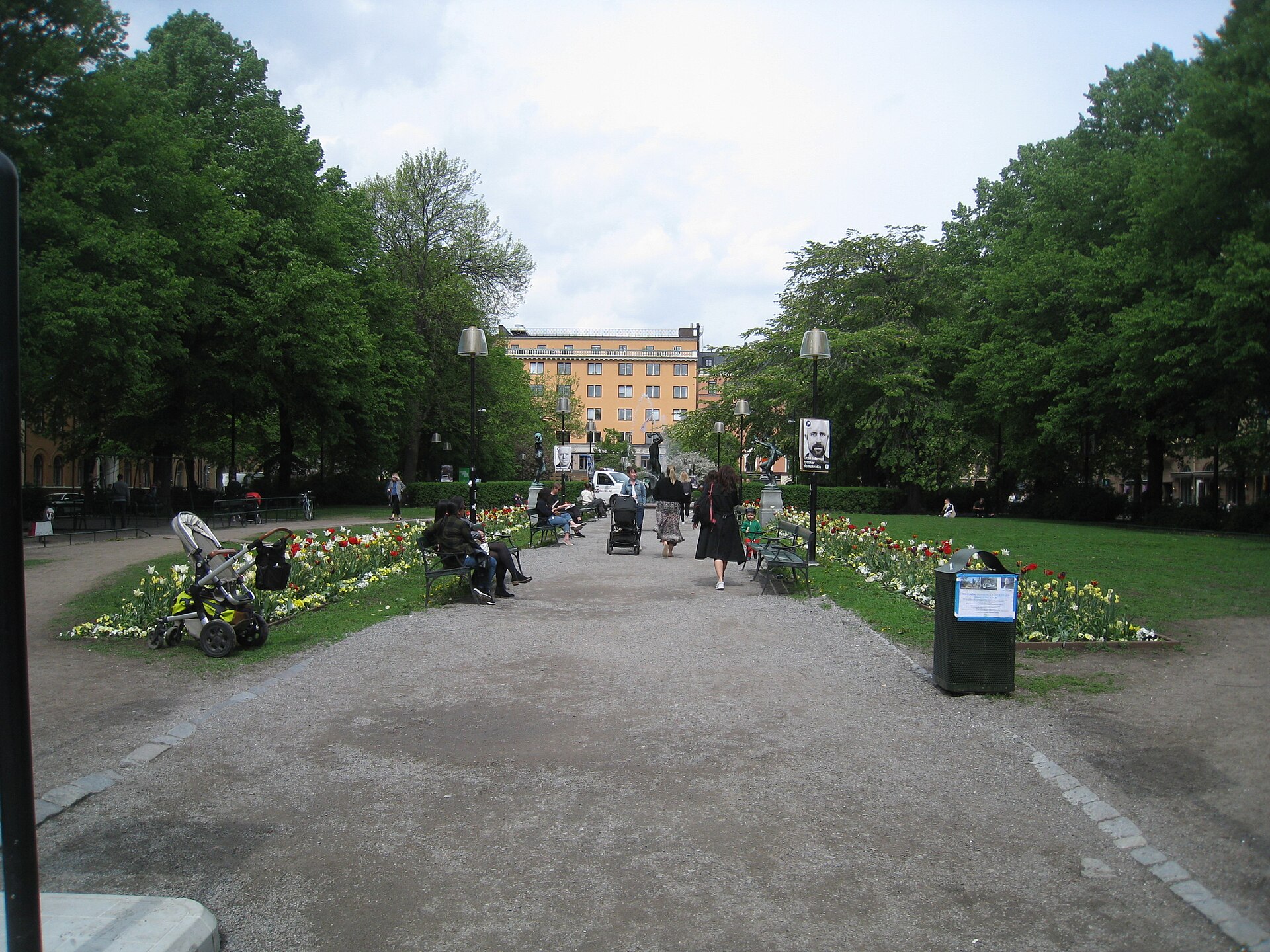
Häktet, the old lock-up with the courtyard, is the best-known address. The rest of the area is unremarkable in the best sense — competent neighbourhood places where you can get a table at nine on a Thursday. It is also the most sensible place on Södermalm to start a crawl, because everything else on the island is downhill or eastwards from here.
Norrmalm and the centre
Brunkebergstorg — the best square in Stockholm for a drink
Ten years ago nobody crossed this square voluntarily. Now it holds Röda Huset a minute away on Malmskillnadsgatan — currently ranked No. 31 in the world — A Bar Called Gemma on the square itself, and a rooftop directly above. If your priority is the quality of what is in the glass rather than the size of the crowd, this is where to spend the evening.
It is a small area and it is not a night out in the sense of moving between places; it is two or three excellent drinks and then a metro somewhere else. Treat it as the first act. The full list of what to drink here is in our guide to Stockholm’s best cocktail bars, and the hidden doors nearby are in the speakeasy guide.
The rest of Norrmalm — convenient and mostly skippable
Around the central station and along the big shopping streets, the bars exist to serve people who did not plan. They are fine. They are also three times the price of Medborgarplatsen for the same beer, and the crowd is whoever happened to be nearby. If you are staying in Norrmalm and have not decided where to go, the answer is almost always a fifteen-minute walk or one metro stop away rather than downstairs.
Östermalm and Stureplan
Stureplan is the area everyone has heard of and the one most likely to disappoint. It is Stockholm’s expensive quarter: bottle service, guest lists, doors that run 23+ and sometimes 25+ on weekends, and a bar-to-value ratio that is the worst in the city.
That said, it delivers exactly one thing better than anywhere else — a dressed-up, late, high-energy club night. If that is genuinely what you are after, Stureplan is where it lives and nowhere else in Stockholm comes close. The nightclubs guide covers the venues and the door politics in detail.
Practical notes: get there before 23:30 or accept the queue, go in a balanced group if you can, and expect SEK 150–250 entry plus a compulsory coat check. Lucy’s Flower Shop, the best hidden bar in the city, is on Birger Jarlsgatan a couple of minutes from the square and is a far better use of an hour than most of what surrounds it. The rest of Östermalm east of Stureplan is quiet and residential after dark.
Vasastan — where the locals go
North of the centre, Vasastan is the quiet counter-argument to all of the above. No landmark venue, no scene, no queue — just a high density of small bars between Odenplan and Sankt Eriksplan where the prices have not been adjusted for tourism and the bartender has time to talk to you.
The area’s best rooms are deliberately hard to spot: Corner Club’s unmarked frosted door on Odengatan, Apropos under a small green awning at Sankt Eriksplan. Both are small, both fill early, and neither is a place for a group of six. Arrive before nine and Vasastan is the most pleasant drinking in the city. Arrive at eleven and you will be walking.
It is also the right area for a weeknight, when Södermalm is quiet and Stureplan is closed to anyone not on a list. More on the district in the Vasastan guide.
Kungsholmen — the underrated one
Kungsholmen is where Stockholmers live rather than where they go out, and around Fridhemsplan that translates into a modest, genuinely local scene: neighbourhood bars, a few good restaurants, waterfront walks along Norr Mälarstrand, and nothing at all that resembles a queue.
It will not give you a big night. It will give you a good, cheap, unhurried evening ten minutes from the centre, which on a Tuesday is often the better deal. The Kungsholmen guide has the daytime version.
Gamla Stan — beautiful, and mostly a trap after dark
The old town looks like it should be the best place in Stockholm for an evening and is not. Västerlånggatan, the main lane, is tourist-priced from end to end — SEK 190 cocktails made without much interest. The medieval cellars are atmospheric and expensive in roughly equal measure.
There are exceptions, and they are worth knowing: Pharmarium on Stortorget is a genuinely excellent bar on the site of Sweden’s first pharmacy, and there is a serious gin bar in the quarter. Beyond those, treat Gamla Stan as a place to walk through at dusk on the way somewhere else. It is a spectacular walk.
Areas that are not ready yet
Slussen has been a construction site since 2016 and will be one until 2027. The bus terminal finished in 2025 and Mälarterrassen — a terrace with space for six restaurants and outdoor seating looking across at Gamla Stan — opens during 2026, which will eventually make this one of the best evening spots in the city. It is not that yet. For now Slussen is a place you change trains, not a place you drink.
Hammarby Sjöstad, the waterfront district southeast of Söder, has a handful of pleasant places and no critical mass. Lovely on a summer afternoon, thin on a Friday night.
What a night costs by area
| Area | Beer (SEK) | Cocktail (SEK) | Entry | Crowd |
|---|---|---|---|---|
| Medborgarplatsen | 65–85 | 130–160 | Rarely | 20s, students |
| Hornstull | 80–95 | 155–185 | No | Local, 25–40 |
| SoFo / Nytorget | 80–100 | 150–185 | No | Local, 30s |
| Vasastan | 75–95 | 155–195 | No | Local, mixed |
| Brunkebergstorg | 90–110 | 175–210 | No | Mixed, hotel |
| Stureplan | 95–120 | 180–220 | 150–250 | Dressed, 23+ |
| Gamla Stan | 90–110 | 170–195 | No | Visitors |
Budget roughly SEK 600–900 per person for a full night out including entry and a taxi share, less if you stay south of Slussen and use the metro. The Stockholm trip cost guide puts that against the rest of a trip.
Timing: the thing most visitors get wrong
Stockholm runs late but starts late, and the gap catches people out.
- 18:00–20:00 — after-work (afterwork is a Swedish noun and a Swedish institution). Cheap food deals, busy bars, over by eight.
- 20:00–21:00 — the quiet hour. Restaurants are full, bars are half empty. This is when to get a seat at a small room.
- 21:00–22:30 — bars fill properly. After this, small venues are standing-room or closed to you.
- 23:00–00:30 — clubs open and fill. Arriving at a Stureplan door at 01:00 is a queue, not a plan.
- 01:00–03:00 — most bars stop serving; clubs run to three and occasionally five.
The single most useful adjustment for a visitor is to move everything an hour earlier than feels natural. You get seats, you get served, and you still finish at the same time as everyone else.
Getting between areas, and getting home
Almost everything in this guide is within twenty minutes of everything else, which is the real argument for Stockholm as a going-out city. Hornstull to Brunkebergstorg is twelve minutes on the red line. Medborgarplatsen to Odenplan is nine on the green.
The metro runs all night on Friday and Saturday nights, which removes the usual reason to leave early; on other nights it stops around 01:00 and night buses take over. Details in the metro guide and the SL card guide. If you would rather not, taxis and Uber in Stockholm covers the one genuinely important rule: agree the price or use an app, because Swedish taxi fares are deregulated and the number on the roof means nothing.
Areas by night of the week
Stockholm’s going-out geography shifts noticeably across the week, and following it saves you from empty rooms.
Monday and Tuesday — Vasastan and Kungsholmen. Small local bars that stay open regardless. Most of Södermalm is asleep and Stureplan is shut.
Wednesday and Thursday — the best nights in the city. Everything is open, nothing is full, and you can walk into rooms that are impossible at the weekend. Hornstull and SoFo are at their best.
Friday and Saturday — everywhere works, everywhere queues. Book, go early, or go to Medborgarplatsen where capacity is not the problem.
Sunday — thin. A handful of bars in Söder and Vasastan, hotel bars, and not much else. A good night for dinner rather than drinking.
Seasonal shifts
The areas themselves change with the light, which is more dramatic here than almost anywhere in Europe.
Summer (June–August) pushes everything outdoors. Hornstull’s west-facing waterfront, Mariatorget’s edges, rooftop terraces and the Djurgården canal all come alive, and the long evening light means outdoor seating is full from five. This is also when Stockholmers leave for the archipelago, so the city can feel oddly quiet in mid-July even while the terraces are busy.
Autumn (September–November) is the connoisseur’s season. The terraces shut, the good indoor rooms have space again, and the city refills with people who live there.
Winter (December–February) splits in two. December is the busiest drinking month of the year thanks to the julbord season, with company parties filling every reasonable venue for three weeks. January and February are the quietest, cheapest and easiest nights of the year to go out, if you can handle the dark.
Spring (March–May) is the wait. Nothing outdoor opens reliably until late April, and Walpurgis on 30 April is the night the city decides summer has started whether or not the weather agrees.
Common mistakes
- Picking an island instead of a square. “Let’s go to Södermalm” means a forty-minute walk between the wrong bars. Pick Hornstull, or Nytorget, or Medborgarplatsen.
- Starting at 22:00. By then the small rooms are full. Start at 20:00 and you get the same night with seats.
- Going out in Gamla Stan. Walk through it, eat elsewhere, drink elsewhere.
- Turning up at Stureplan in a group of six men. This is the classic refused-at-the-door scenario in Stockholm. Split up or go somewhere with no door.
- Assuming Slussen is finished. It is not, until 2027.
- Planning a bar crawl across the water. The bridges are long and the wind off Riddarfjärden in November is a genuine deterrent. Stay on one island per evening.
Three evenings that work
The easy one. Metro to Hornstull at 19:30. Eat on Hornsbruksgatan, drink at Tjoget, move to Linje Tio when it gets loud, walk home or take the red line. No bookings, no doors, no decisions.
The good-drinks one. Start at Brunkebergstorg at 19:30 for one excellent cocktail. Walk ten minutes to Birger Jarlsgatan and try Lucy’s. Metro north to Odenplan and finish in Vasastan. Two of these three have limited seats, so go early and in twos.
The late one. Dinner in SoFo at 19:00, drinks around Nytorget until 22:30, Medborgarplatsen or a Söder club after that, late-night food on the square, night bus or the all-night metro home. This is the night that actually goes past two.
For fuller itineraries covering days as well as evenings, see the Stockholm weekend itinerary.
Frequently asked questions
Where is the best place to go out in Stockholm?
Hornstull on western Södermalm is the best all-round area — dense, walkable, no door policies, and a mix of good bars in four streets. For serious cocktails go to Brunkebergstorg in Norrmalm; for a cheap loud night go to Medborgarplatsen; for dressing up and a club go to Stureplan.
Where do locals go out in Stockholm?
Vasastan between Odenplan and Sankt Eriksplan, and the SoFo blocks around Nytorget on Södermalm. Both are residential areas with small bars, no queues and prices that have not been adjusted for visitors. Kungsholmen around Fridhemsplan is the quietest local option.
Is Södermalm or Östermalm better for nightlife?
Södermalm, for almost everyone. It is cheaper, friendlier, denser and has no door policies worth worrying about. Östermalm and Stureplan are better only if you specifically want a dressed-up club night, which they do better than anywhere else in Sweden.
What night of the week is best to go out in Stockholm?
Wednesday or Thursday. Everything is open, nothing is full, and you can walk into rooms that are impossible on a Saturday. Friday and Saturday are busiest; Sunday and Monday are thin.
What time do people go out in Stockholm?
Bars fill between 21:00 and 22:30 and clubs from 23:00. Most bars stop serving between 01:00 and 03:00, with clubs running to 03:00 or occasionally 05:00. Arriving an hour earlier than feels natural is the single best adjustment a visitor can make.
Is Slussen worth going to at night?
Not yet. Slussen has been a construction site since 2016 and the full transport hub completes in 2027. Mälarterrassen, with space for six restaurants and outdoor seating facing Gamla Stan, opens during 2026 and should eventually make it excellent. For now, change trains and go elsewhere.
How much does a night out in Stockholm cost?
Roughly SEK 600–900 per person including entry and transport. Beer runs SEK 65–120 depending on the area, cocktails SEK 130–220, and Stureplan club entry SEK 150–250. Medborgarplatsen is the cheapest area and Stureplan the most expensive.
Is it safe to go out at night in Stockholm?
Yes. Stockholm is a low-crime city by European standards and the central going-out areas are busy and well lit. The metro runs all night at weekends and is safe to use. Normal city precautions apply, particularly around the larger club areas at closing time.
Where should I go out in Stockholm in winter?
Vasastan and Södermalm — small indoor rooms rather than anything with a terrace. January and February are the quietest and cheapest nights of the year. December is the busiest month because of company julbord parties, so book.
Can you walk between Stockholm’s nightlife areas?
Within an island, yes, easily. Between islands, less so — the bridges are long and exposed, and the wind off the water in winter is a real deterrent. Stay on one island per evening and use the metro to move between them.
More Stockholm guides
- Stockholm Nightlife — the full guide to going out in the city.
- Stockholm Nightlife by Neighbourhood — the district-level picture.
- Best Cocktail Bars in Stockholm — where the good drinks are.
- Best Speakeasy Bars in Stockholm — the unmarked doors.
- Best Nightclubs in Stockholm — the late end of the night.
- Live Music in Stockholm — evenings built around a stage.
- Södermalm Guide — the island with four going-out areas.
- Stockholm Weekend Itinerary — how the evenings fit around the days.
Photo credits
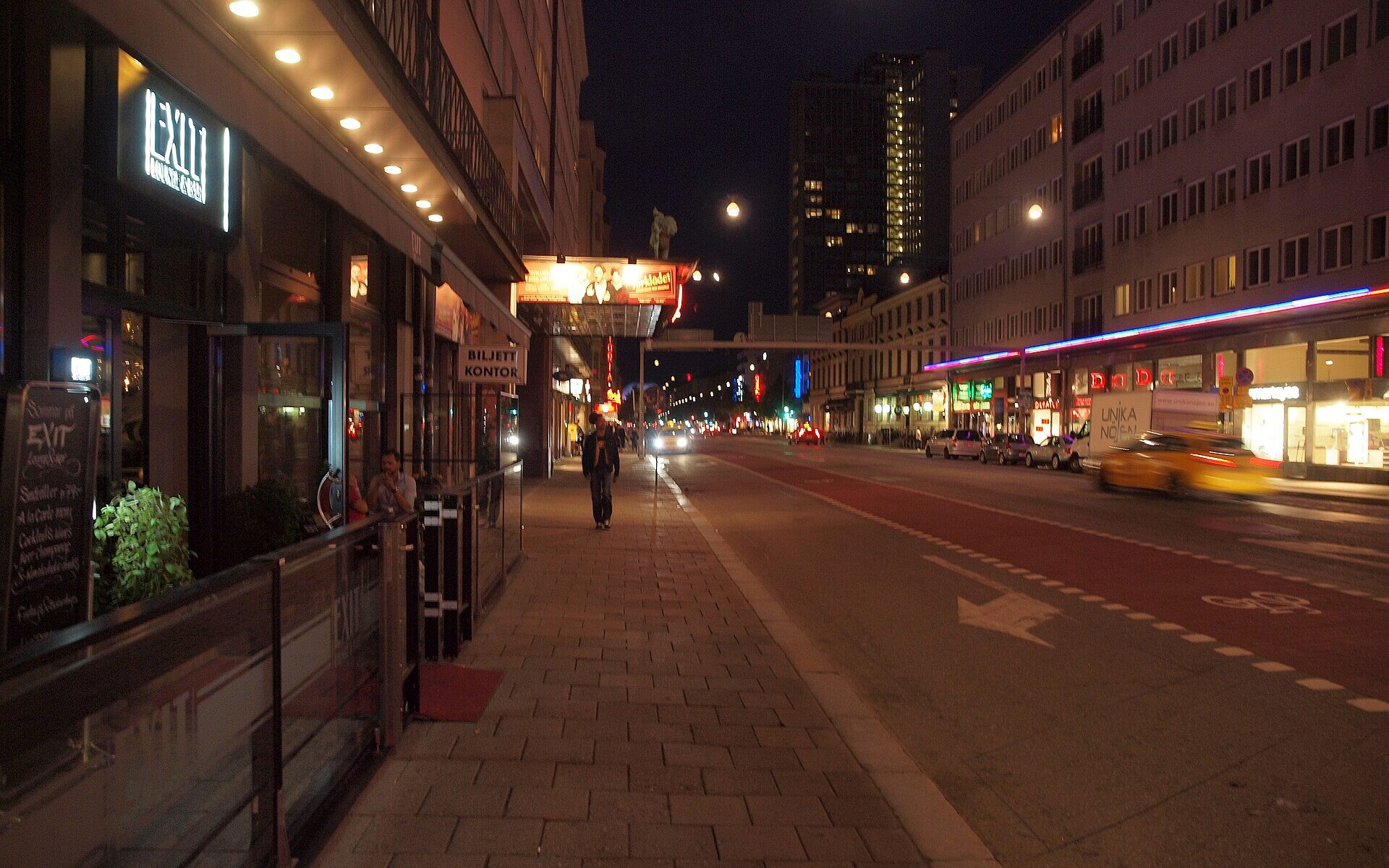
Götgatan at night: Götgatan, Stockholm at night by JIP, CC BY-SA 3.0, via Wikimedia Commons.
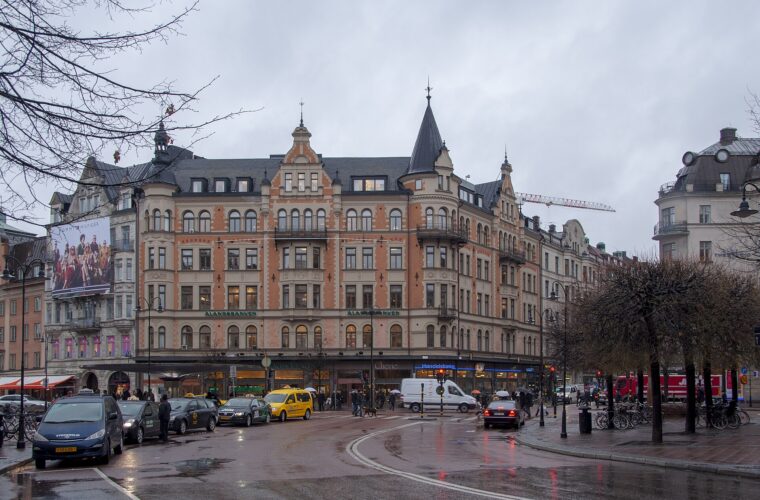
Mariatorget: Mariatorget, vy mot norr, 2019a by Bysmon, CC BY-SA 4.0, via Wikimedia Commons.