Hop-On Hop-Off Stockholm: Routes, Prices and Is It Worth It?
Stockholm's hop-on hop-off bus, honestly assessed: the 15-stop route, 2026 prices and timetable, who it genuinely suits, and the tram-and-ferry loop that does the same job all year.
Type hop on hop off Stockholm into a search engine and you’ll get page after page of booking sites selling the same open-top buses, each one promising the easiest way to see the city. What they rarely mention is that Stockholm is a city that seldom needs one. The centre is compact, most of the big sights sit along the water within half an hour’s walk of each other, a public tram runs out to the museum island, and a commuter ferry crosses the harbour for the price of a metro ticket. So is the bus a waste of money? For most visitors, most of the time, yes. For a smaller group it’s genuinely the right choice, and by the end of this page you’ll know which group you’re in.
Below you’ll find the route stop by stop, what each ticket costs, when the buses run (and when they don’t), how the bus-and-boat ticket works, and the do-it-yourself loop on public transport that covers the same ground. Prices and timetables were checked on the operator’s own website in September 2026; treat them as the right order of magnitude, because online discounts and combination deals shift through the season.
Operator: Strömma, which runs its own green buses and the red City Sightseeing buses on the same route. One ticket is valid on both.
Route: a loop of 15 stops through the centre, Gamla Stan, Södermalm, Djurgården and Östermalm, starting on Strömgatan by the Royal Opera. A full lap takes about an hour.
Price: SEK 365 for 24 hours, or SEK 328 if you buy online. Bus-and-boat tickets from about SEK 410 online.
Season: the 2026 season ran from 5 May to 1 November. No buses in winter. Check Strömma’s bus page for next season’s dates before you book.
Hours: in 2026, departures from 10:00, with the last at 16:00 or 17:00 depending on the period. Summer buses left every 20 or 30 minutes; the autumn timetable was irregular, with gaps of more than an hour.
Our verdict: skip it if you walk comfortably and have an SL travel ticket. Buy it if walking is hard, if you’re wrangling small children or older relatives, or if it comes free with a pass you already own.
How Stockholm’s hop-on hop-off bus works
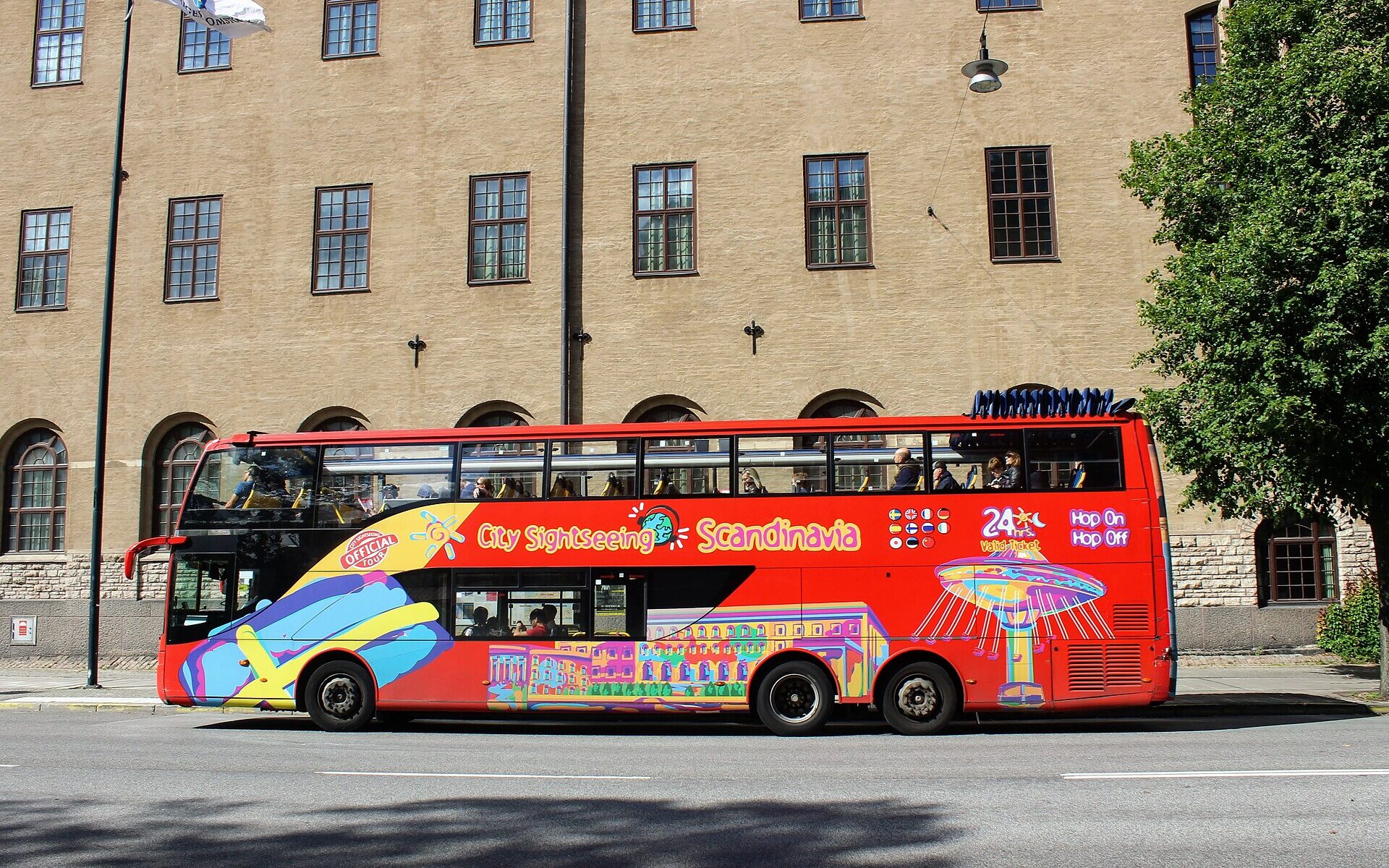
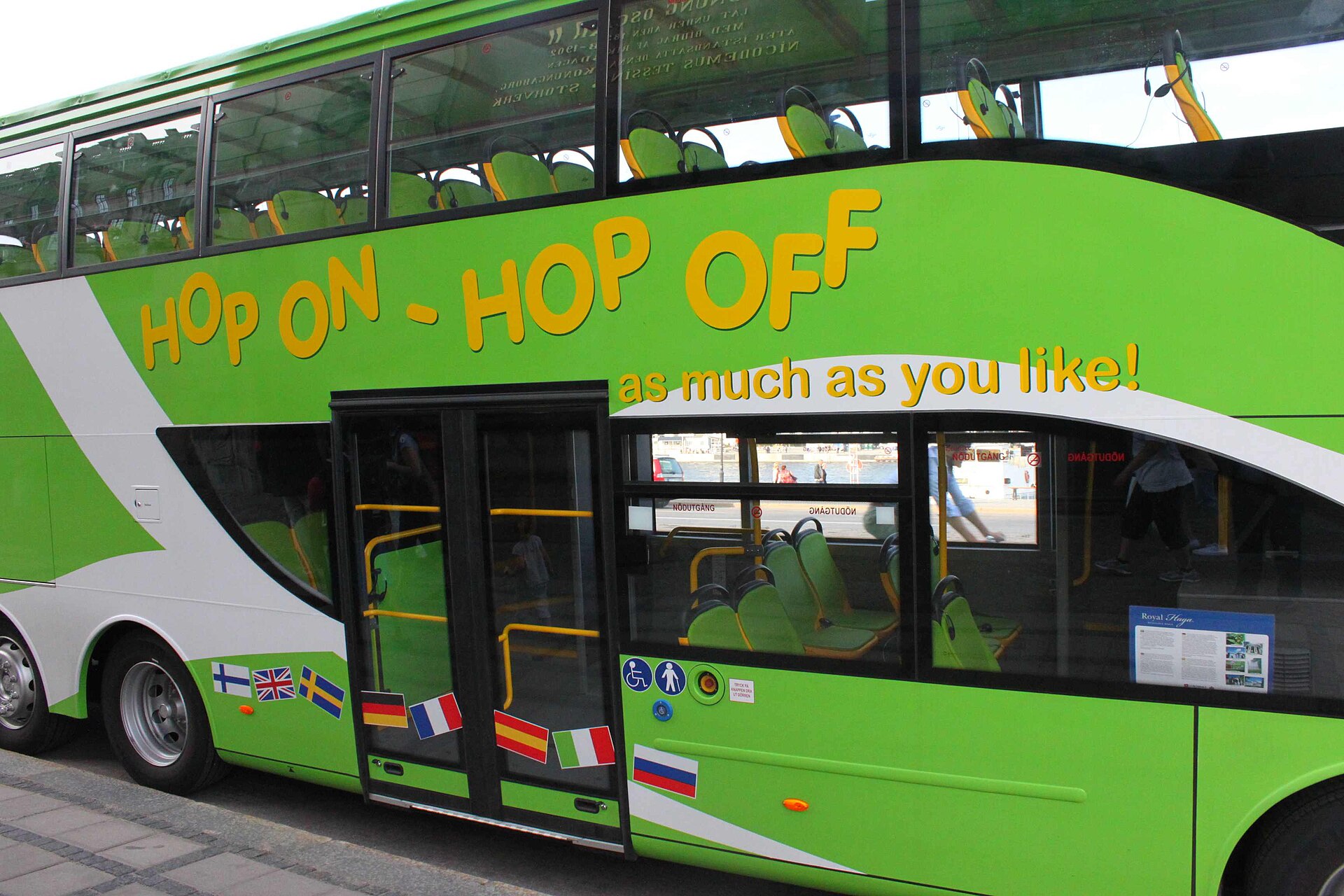
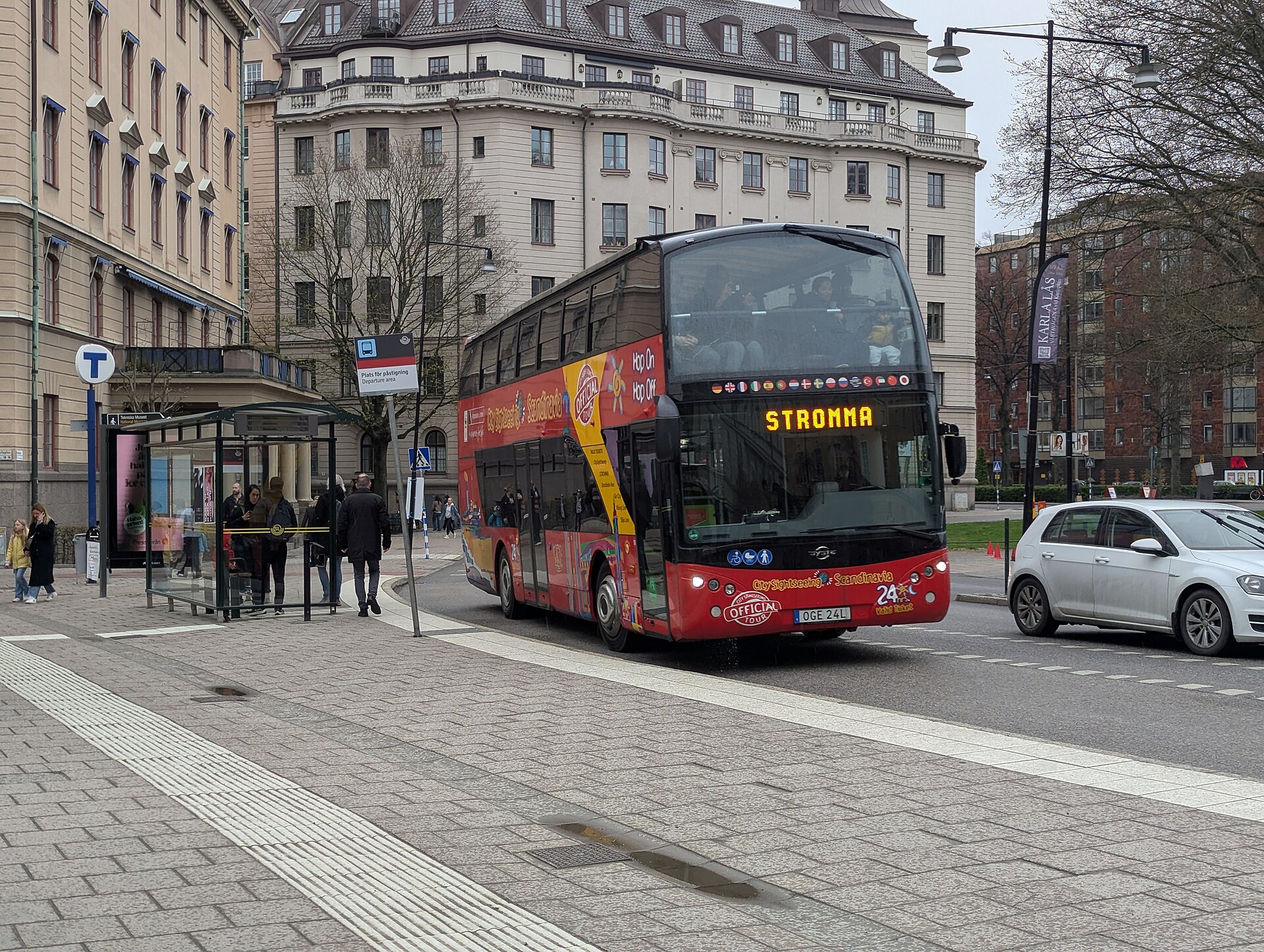
There’s less choice than the search results suggest. Stockholm’s hop-on hop-off bus is run by Strömma, the big sightseeing company behind many of the tour boats you’ll see in the harbour, and it runs two liveries on one route: its own green Hop On-Hop Off buses and the red City Sightseeing buses you may recognise from other European cities. A ticket bought for one is valid on the other, so it doesn’t matter which colour turns up. Most of the apparently different hop-on hop-off tours on the big booking platforms are the same product, resold at a slightly different price.
The idea is simple enough. You buy a ticket, board at any stop, ride the loop with recorded commentary, get off wherever you like and catch a later bus when you’re done. The buses are double-deckers with an open upper deck in fine weather, free Wi-Fi on board and, on most vehicles, a ramp for wheelchair users. There’s no toilet on board, which matters more than it sounds on a loop that takes an hour.
Where it starts
The first stop is on Strömgatan, beside the Royal Opera and directly across the water from the Royal Palace. You don’t have to start there: you can board at any of the 15 stops, and if your hotel is near Stureplan or Hötorget, joining the loop there saves a walk. But Strömgatan is where the day’s first buses set off, so first thing in the morning it’s usually the easiest place to get a seat on the top deck.
The route, stop by stop
The loop has 15 stops. Here they are in order, with what’s nearby and whether we think each one earns getting off the bus.
| Stop | What’s there | Worth getting off? |
|---|---|---|
| 1. Strömgatan and the Royal Opera | The start of the loop; Kungsträdgården and Gustav Adolfs torg a few steps away | Board here |
| 2. Gamla Stan and the Royal Palace | The palace, Storkyrkan, Stortorget and the Nobel Prize Museum | Yes, and then walk |
| 3. Slussen | The gateway to Södermalm, still a building site; the Djurgården ferry leaves from the quay | Only to change to the ferry |
| 4. Katarinavägen | The cliff road above the Stadsgården quays, with Fotografiska below | For Fotografiska or a cruise ship |
| 5. Medborgarplatsen | Södermalm’s main square, Götgatan and the SoFo streets | Yes, for cafés and vintage shops |
| 6. Kungsträdgården | The park, the NK department store and the painted metro station below | Maybe |
| 7. Strandvägen | The grand waterfront boulevard and its moored boats | Better walked than ridden |
| 8. Vasa Museum and Nordic Museum | The Vasa warship, Nordiska museet and Junibacken | Yes |
| 9. ABBA The Museum and Gröna Lund | ABBA The Museum and the amusement park | Yes, in season |
| 10. Skansen | The open-air museum and its Nordic zoo | Yes |
| 11. Karlaplan | Residential Östermalm; the Swedish History Museum is a short walk | Rarely |
| 12. Stureplan | Upmarket shopping and bars; Östermalms Saluhall is five minutes away | For the food hall |
| 13. Hötorget | The Concert Hall, the outdoor market and Hötorgshallen | Maybe |
| 14. Kungsgatan | The main shopping streets, with Drottninggatan close by | For shopping |
| 15. City Hall | Stadshuset, its tower and the waterfront garden | Yes, but book the tour first |
The centre and the old town
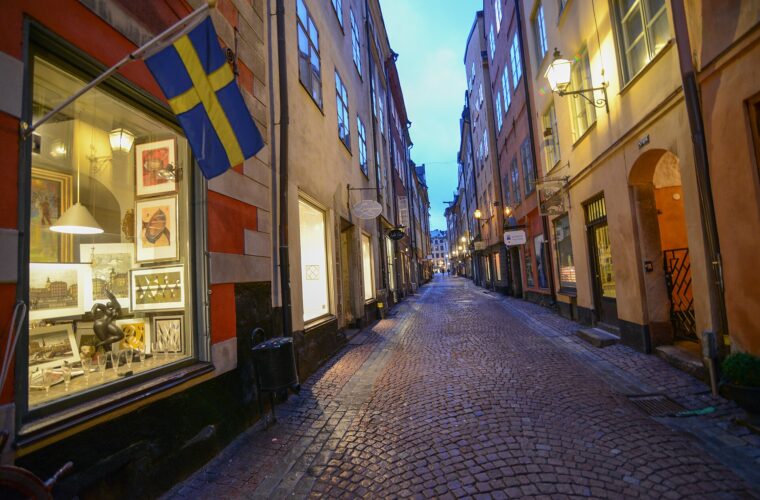
The first two stops are where the bus makes the least sense. From Strömgatan the Royal Palace is a five-minute walk across Norrbro, and the old town beyond it is a warren of lanes too narrow for any bus. Get off at stop 2 and you’ll be doing Gamla Stan on foot anyway, which is how it should be done: slowly, with detours into the courtyards and a coffee on Stortorget. Our Gamla Stan guide has a route through it, and the Royal Palace guide covers the state apartments and the changing of the guard.
Södermalm
Slussen is mid-rebuild and will be until 2029, so it isn’t a place to linger; the stop is mostly useful because the Djurgården ferry leaves from the quay nearby. The next stretch is the best bit of the whole ride. Katarinavägen runs along the cliff above the Stadsgården quays, and from the top deck you look straight across the harbour to Skeppsholmen, Djurgården and the rides of Gröna Lund. Fotografiska sits on the quay below. Then the bus turns inland to Medborgarplatsen, the square at the heart of Södermalm and a short walk from the cafés, bars and second-hand shops of SoFo. If you’re going to get off anywhere south of the water, make it here. Our Södermalm guide will happily fill an afternoon.
The waterfront and Djurgården
From Medborgarplatsen the loop heads back north past Kungsträdgården and runs out along Strandvägen to Djurgården, the island of museums. This is the leg that sells the bus: three stops cover the Vasa Museum, Nordiska museet, ABBA The Museum, Gröna Lund and Skansen, which between them could fill two full days. It’s also the leg where public transport does the job just as well. Tram 7 runs from the city centre along the same waterfront to the same museums, and the Djurgården ferry brings you back across the harbour to Slussen. More on that below, and in our Djurgården guide.
Östermalm and back to the centre
The last third of the loop is the part most riders sit through. Karlaplan and Stureplan are the smart residential and shopping heart of Östermalm, worth a wander if you like that sort of thing, and Östermalms Saluhall, the city’s grandest food hall, is a few minutes’ walk from Stureplan. Hötorget and Kungsgatan are the everyday shopping centre. The final stop, City Hall, is one of the few sights on the route you can’t simply walk into: the interiors are shown on guided tours only, and they sell out in summer. If it’s on your list, book the tour before you board and use the bus to get there. Our Stockholm City Hall guide has the tour times.
Prices and tickets in 2026
Strömma charges more for a ticket at the stop than online, so the one easy saving is to buy on its website before you go. These were the adult prices in September 2026.
| Ticket | Price | Notes |
|---|---|---|
| Hop-on hop-off bus, 24 hours | SEK 365, or SEK 328 online | Valid on the green and the red buses |
| Bus and boat combination | SEK 455, or from about SEK 410 online | Check the validity period on the ticket you pick |
| Bus for 24 hours plus ABBA The Museum | From SEK 569 | Only if you’d go to ABBA anyway |
| Bus for 24 hours plus the Viking Museum | From SEK 455 | Only if the Viking Museum is on your list anyway |
The museum combinations only make sense if the museum was on your list already. The bus-plus-Viking-Museum ticket starts at SEK 455, so buy it if the Viking Museum on Djurgården was in your plans anyway. The ABBA bundle, from SEK 569, works on the same logic, but only if you’d have gone to ABBA The Museum regardless. Don’t let a bundle talk you into a museum you weren’t planning to see; that’s how a SEK 328 bus ride becomes a SEK 569 afternoon.
Longer tickets are sold too, so check Strömma’s booking page for children’s prices and for your dates. You’ll also find the same tickets on the big booking platforms, sometimes quoted in euros. Compare the final price with Strömma’s own online price, which is usually the one to beat, and read the small print on anything sold as a voucher.
If you’ve already bought a sightseeing pass that includes the hop-on hop-off bus, the maths changes completely. The bus now costs you nothing extra, so treat it as a free shuttle to Djurgården and ignore most of this page. Our Stockholm Pass vs Go City comparison sets out which pass includes what, and whether either pays back.
Season, hours and frequency
This is the part the booking sites bury. The bus doesn’t run all year, doesn’t run in the evening, and in spring and autumn doesn’t run especially often. Here’s the 2026 timetable as Strömma published it.
| Period (2026) | Departures | Frequency |
|---|---|---|
| 5 May – 21 June, Monday to Thursday | 10:00–16:00 | Every 30 minutes |
| 5 May – 21 June, Friday to Sunday | 10:00–17:00 | Every 20 minutes |
| 22–30 June | 10:00–16:00 | Every 20 minutes |
| 1 July – 31 August | 10:00–17:00 | Every 20 minutes |
| 1 September – 1 November (daily to 18 October, then Thursday to Sunday from 22 October) | 10:00, 10:30, 11:15, 11:50, 12:55, 13:15, 14:20, 15:00 and 16:00 | Irregular, 20 to 65 minutes apart |
Three things follow from that timetable. First, the last departure is in the middle of the afternoon, so the bus is no use for getting back from a late museum visit or out to dinner, and in a city where June evenings stay light long after the last bus, that’s a lot of good sightseeing time without it. Second, the autumn departures are irregular, and twice in the middle of the day there’s more than an hour between buses, so if you hop off at Skansen around noon you may be waiting a while. Third, from early November to early May there’s no hop-on hop-off bus at all. The 2026 season ended on 1 November; expect the 2027 season to begin in May again, but check the dates before you build a day around it.
A full lap takes about an hour in normal traffic. That’s a pleasant hour if you stay on for the whole loop, but it also means that anywhere you want to go next might be most of an hour away by bus, for reasons that the next section explains.
Is the hop-on hop-off bus worth it in Stockholm?
We’ll put it plainly: for most people, no. The bus isn’t bad. It’s clean, the top deck is fun on a sunny day, and nobody who rides it has a miserable time. But in Stockholm specifically it’s an expensive way to do something the city already does well for free or for the price of a travel ticket. Here’s why.
The city is small enough to walk
Stockholm’s big sights sit on a handful of islands packed close together. The two stops furthest apart on the whole route, City Hall and Skansen, are only about three kilometres apart as the crow flies. Most of the walking is along the water and over bridges, and the walking is how you actually see the place: the light on the water, the boats tied up along Strandvägen, the lanes of Gamla Stan that the bus can only drive past. Our guide to walking in Stockholm has routes and distances.
Public transport covers the same ground for less
An SL 24-hour ticket costs SEK 180 and covers the metro, SL buses, tram 7 and the Djurgården ferry; the SL journey planner has the evening departures. Tram 7 follows the bus’s most useful leg, from the centre along Strandvägen to the Vasa Museum, Gröna Lund and Skansen. The Djurgården ferry crosses from the museum island to Slussen in a few minutes. And the metro gets you from T-Centralen to Gamla Stan, Slussen, Medborgarplatsen and Östermalm faster than anything on the road. A single SL ticket costs about SEK 43 in 2026 and is valid for 75 minutes (check the SL app for the current fare); our SL card guide explains the travel passes, and Stockholm’s buses and trams covers tram 7 in detail.

The loop only goes one way
This is the practical flaw that the marketing never mentions. Like most hop-on hop-off routes, the loop runs in one direction. Say you get off at the Vasa Museum and want to go to Gamla Stan afterwards. By bus, you’d first wait for the next departure, which in autumn can be more than an hour away, then ride on past ABBA, Skansen, Karlaplan, Stureplan, Hötorget, Kungsgatan, City Hall and the Opera before you reach the old town: nine stops, most of the way round the loop. On foot, the same trip is under half an hour along the water. By the Djurgården ferry it’s an eight-minute walk to the jetty at Allmänna gränd and a short crossing to Slussen, which is the more beautiful journey anyway.
What you’re really paying for
Strip away the transport, and what the ticket buys you is the commentary and the view from the top deck. Both are pleasant. Neither is unique. Katarinavägen is a public street, so the view is there for anyone who walks up, and if it’s stories you want, a guide who can answer questions is better company than a recording. Stockholm has tip-based free walking tours of the old town and plenty of paid ones; our Stockholm walking tours guide compares them.
When the bus is the right call
None of that makes the bus a bad product. It makes it a specialist one. It genuinely earns its price in these situations:
- Walking is hard for you. If distances of a kilometre or two are a real obstacle, the bus gives you a seat, a view and a door-to-door link between the main sights without any navigating. Most of the buses have a ramp, but only one wheelchair per bus can be secured, so two wheelchair users travelling together may have to split up or wait for the next bus. Tram 7 is low-floor too, and our Stockholm accessibility guide covers the metro lifts, ferries and step-free routes.
- You’re travelling with small children or older relatives. A bus you can step on and off, with a guaranteed seat once you’re aboard, takes a lot of the friction out of a day with a four-year-old or a grandparent. Pushchairs are allowed if there’s space, which on a busy July afternoon there may not be.
- It comes free with a pass you’ve already bought. Then use it without guilt.
- You’re off a cruise ship at Stadsgården with a few hours ashore. The Katarinavägen stop is the nearest to the Stadsgården quays, and one full lap is a reasonable overview when your time is short. Ships at Frihamnen, where about half of Stockholm’s cruise calls berth, are further out and not on the route; our Stockholm cruise port guide explains the shuttles and city buses from there.
- It’s your first afternoon and you want the lie of the land. One lap, staying on the whole way, is a decent orientation. After that you’ll probably walk.
- You’d pay for the museum anyway. If the Viking Museum or ABBA The Museum is already on your list, the combination ticket makes the bus cheap or close to free.
When to skip it
- You’re comfortable walking a few kilometres a day and you’ll buy an SL ticket anyway.
- You’re visiting between November and April, when it doesn’t run.
- You’re here for one day and want as much museum time as possible. Waiting for the next bus and riding the long way round eats into it.
- You want to be out in the evening, which in a Stockholm summer is the best part of the day.
- You’re on a budget. SEK 328 is roughly the price of a museum ticket plus lunch.
The do-it-yourself loop on public transport
Here’s how to cover the same ground as the bus in a day, with an SL ticket and your own feet, in roughly the same order. It doesn’t depend on the bus season.
Morning: Gamla Stan on foot
Start at T-Centralen and walk south down Drottninggatan or through Kungsträdgården to the water, then over Norrbro past the Riksdag building to the Royal Palace. That’s the bus’s first two stops, done on foot. Spend the morning in Gamla Stan: the palace, Storkyrkan, Stortorget and the lanes off Västerlånggatan. When you’re done, walk down to Slussen at the southern tip of the old town.
Late morning: the ferry to Djurgården
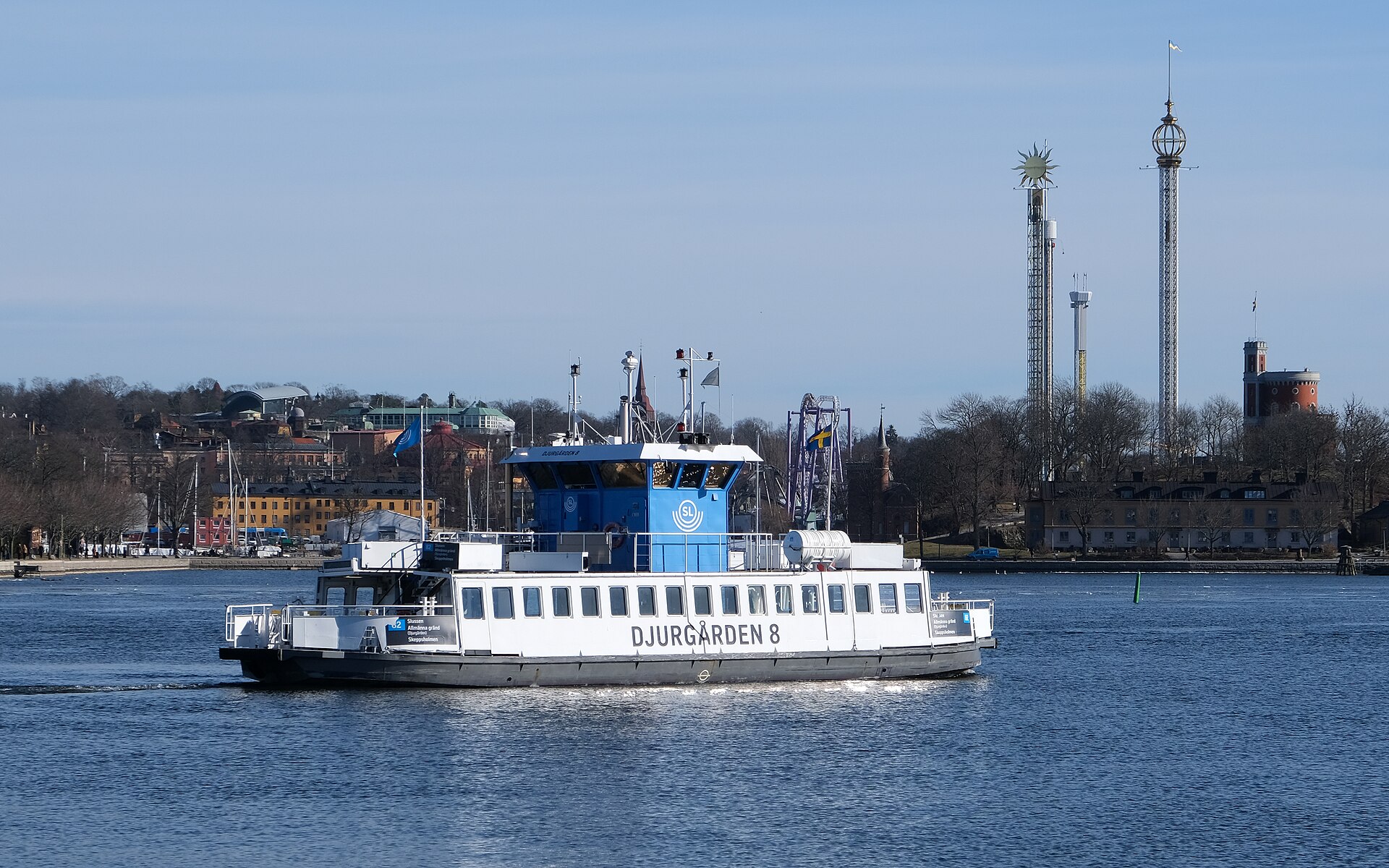
From the quay at Slussen, take the SL Djurgården ferry, line 82, via Skeppsholmen to Allmänna gränd on Djurgården. It’s the same harbour view the hop-on hop-off boat sells, for the price of an ordinary SL ticket, and it drops you beside Gröna Lund and ABBA The Museum. Our Stockholm ferries guide has the details.
Afternoon: the museums, then the tram back
Djurgården’s big three, the Vasa Museum, Skansen and ABBA The Museum, are all within a ten-minute walk of each other, and realistically you’ll manage two in an afternoon. Our guides to the Vasa Museum and Skansen will help you choose. When you’ve had enough, walk to the nearest tram 7 stop and ride back along Strandvägen into the centre. If you have the legs for it, walk Strandvägen instead, past the boats moored along the quay and the grand apartment buildings facing the water.
Late afternoon: Östermalm, Hötorget or City Hall
For the last third of the bus route, take the red line metro to Östermalmstorg for the food hall and the Stureplan shops, or the green line to Hötorget for the market and the Concert Hall. If you booked a City Hall tour, it’s a short walk from Central Station. And unlike the bus, none of this stops in mid-afternoon, so you can stay out for dinner and look up the way home in the SL journey planner.
If you only take one thing from this section, take this: the bus’s three most useful legs have public equivalents on an ordinary SL ticket.
| Bus leg | Do it this way instead | Roughly how long |
|---|---|---|
| Strömgatan to the Royal Palace | Walk across Norrbro | A short walk |
| Gamla Stan to Slussen | Walk through the old town | Depends where you start |
| Slussen to Medborgarplatsen | Green line metro, one stop, or walk up Götgatan | One stop by metro; longer on foot |
| City centre to the Djurgården museums | Tram 7 to Nordiska museet/Vasamuseet, or walk along Strandvägen | About 30 minutes on foot to the Vasa Museum; quicker by tram |
| Djurgården back to the old town | SL Djurgården ferry to Slussen | A short crossing |
| Karlaplan and Stureplan | Red line metro to Karlaplan or Östermalmstorg | A few minutes |
| Hötorget and Kungsgatan | Green line metro to Hötorget, or walk from T-Centralen | Close either way |
| City Hall | Walk from Central Station, south along Vasagatan towards Tegelbacken, then right under the bridge | A short walk |
For a fuller version of this day with meal stops, see our one-day Stockholm itinerary, and if you’re planning a longer stay, Stockholm for first-timers covers the basics.
The hop-on hop-off boat and the bus-and-boat ticket
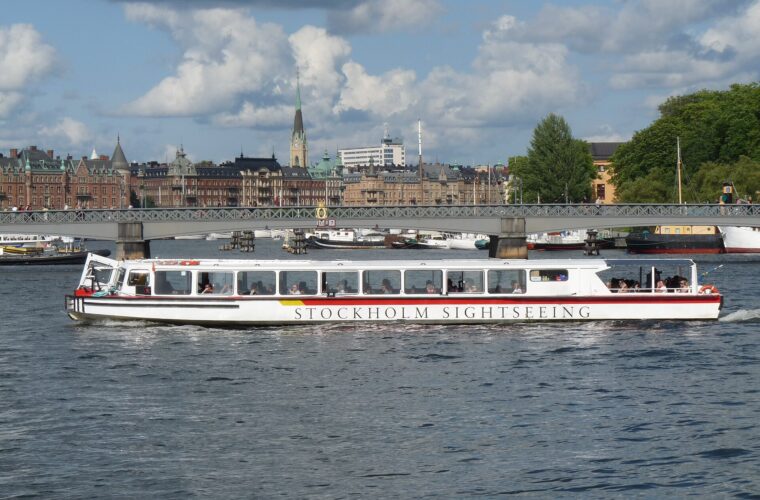
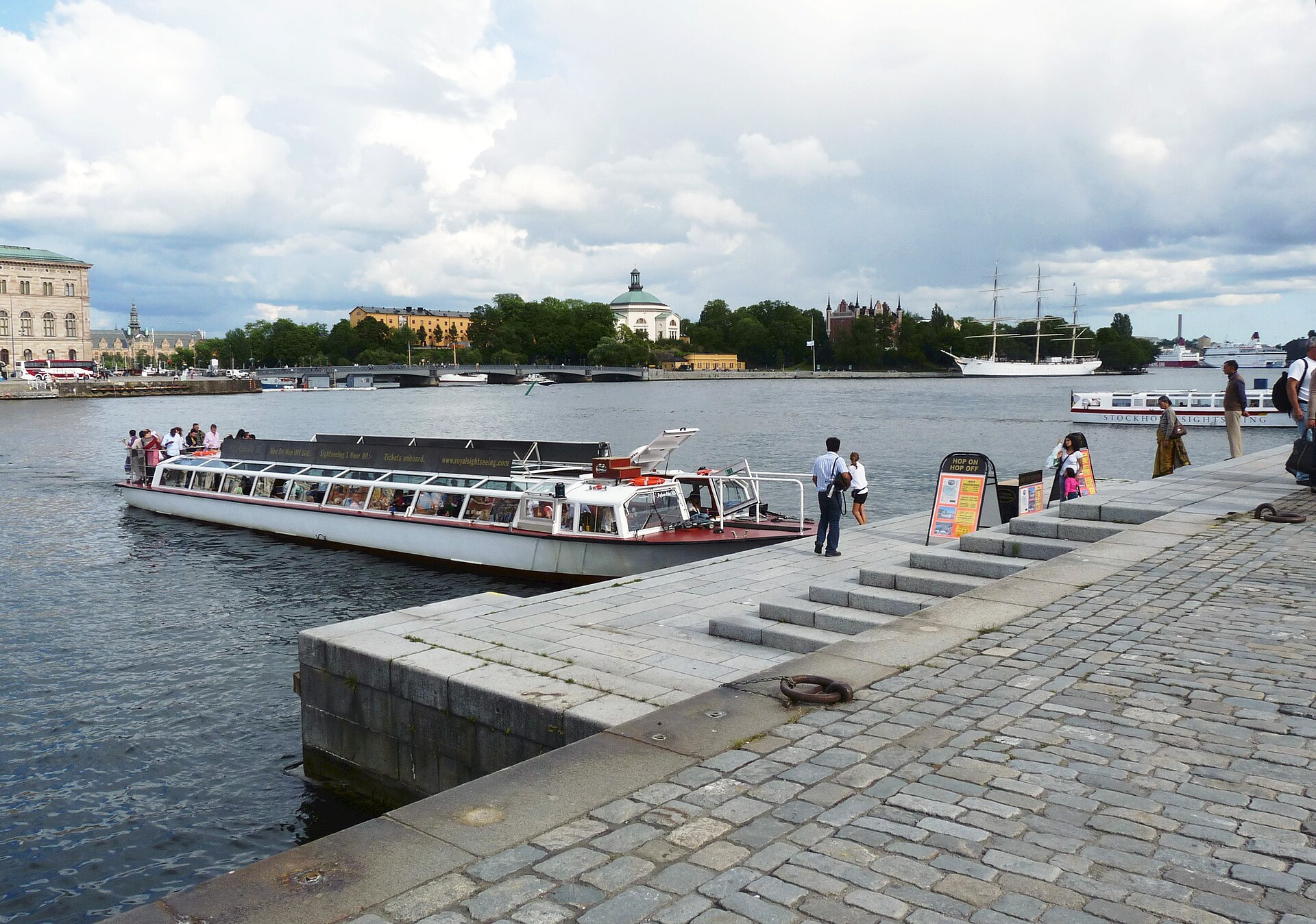
Strömma also runs a seasonal hop-on hop-off boat around the inner harbour, back from 27 May to 12 September in 2027, with stops including the Royal Palace, Skeppsholmen and Djurgården, and it sells the bus and boat together from SEK 410 online. Of the two, the boat is the more Stockholm way to travel. This is a city built on 14 islands, and it looks its best from the water, with the palace and the old town on one side and the green shore of Djurgården on the other.
Before you pay for it, though, look at the Djurgården ferry again. SL’s line 82 runs between Slussen, Skeppsholmen and Djurgården all year, on an ordinary public transport ticket, across the same stretch of harbour. It’s an SL commuter boat rather than a tour, a real Stockholm commute with a view that the city’s residents stop noticing and visitors never do. If you want commentary and a longer look at the water, a proper sightseeing cruise usually beats both; our Stockholm boat tours guide compares them. For the rest of the tour market rated the same way, see Stockholm Tours & Experiences: What Is Actually Worth Booking.
Tips if you do buy a ticket
- Buy online. SEK 328 instead of SEK 365 for the same 24 hours.
- Ride the whole loop first. Stay on for one full lap of about an hour before you get off anywhere. You’ll see how the city fits together, and after that the ticket is simply transport.
- Start early. The first buses leave at 10:00 and the last at 16:00 or 17:00, depending on the period. Check how long your ticket is valid and when its clock starts before you plan around it.
- Mind the autumn lunch gap. In autumn 2026 there was more than an hour between the 11:50 and 12:55 departures, and again between 13:15 and 14:20. Plan a long museum visit over lunch rather than a quick stop.
- Take a layer. The open top deck catches the wind off the water, even in July.
- Book City Hall before you board. The bus will take you there, but only the guided tour gets you inside, and the tours fill up.
- Don’t let the bus run your day. If the place you want is ten minutes’ walk away and the next bus is 25 minutes off, walk. The ticket is a convenience, not an obligation.
- Keep an SL ticket too. The bus stops mid-afternoon and the metro doesn’t. For the evening, and for any leg the loop does the long way round, you’ll want one anyway.
In winter: what to do instead
From November to April there’s no hop-on hop-off bus, and the sightseeing boat timetables thin out too. The good news is that the Djurgården ferry carries on: SL’s line 82 crosses to the museum island all year. Winter is also the best time to be indoors in the big museums, which run all year, and the short days make the walking distances shorter than they feel in summer, because you won’t want to linger. Our guide to Stockholm in winter covers what’s open, and Stockholm when it rains has the indoor options for any season.
Frequently asked questions
How much does the hop-on hop-off bus cost in Stockholm?
In 2026 a 24-hour ticket cost SEK 365, or SEK 328 bought online from the operator, Strömma. Bus-and-boat tickets start at SEK 410 online. The 24-hour bus bundles start at SEK 569 with ABBA The Museum and SEK 455 with the Viking Museum; the SEK 530 and SEK 350 versions swap the bus for the boat, which is back in May 2027.
Is the hop-on hop-off bus worth it in Stockholm?
For most visitors, no. The centre is compact and walkable, and an SL travel ticket covers tram 7 to the Djurgården museums and the Djurgården ferry; a 24-hour ticket costs SEK 180. The bus is worth it if walking is difficult, if you’re travelling with small children or older relatives, or if it comes with a pass you already have.
When does the hop-on hop-off bus run?
The 2026 season ran from 5 May to 1 November, with departures from 10:00 and the last at 16:00 or 17:00 depending on the period. Summer buses ran every 20 or 30 minutes; in autumn the timetable was irregular, with more than an hour between some midday departures. Check Strömma’s bus page for the 2027 timetable.
Does the hop-on hop-off bus run in winter?
No. There’s no hop-on hop-off bus from early November to early May. In winter, the SL Djurgården ferry and a walk along Strandvägen cover the most useful parts of the route; the ferry takes an ordinary SL ticket.
How long does the full loop take?
About an hour in normal traffic. The route runs one way round, so getting from one stop to the previous one can take most of that hour.
Where does the hop-on hop-off bus start?
On Strömgatan, beside the Royal Opera and across the water from the Royal Palace. You can board at any of the 15 stops, including Gamla Stan, Djurgården’s museums, Stureplan, Hötorget and City Hall.
Is the Stockholm hop-on hop-off bus wheelchair accessible?
Most of the buses have a ramp, but only one wheelchair per bus can be secured. Tram 7 to Djurgården is low-floor, which makes it a good alternative.
Is there a hop-on hop-off stop near the cruise terminals?
Katarinavägen, above the Stadsgården quays, is the nearest stop for ships berthed at Stadsgården. Frihamnen, where about half of Stockholm’s cruise calls berth, is not on the route.
More Stockholm guides
- Stockholm Tours & Experiences — which tours are worth booking.
- Stockholm Boat Tours — every boat trip compared.
- Stockholm Walking Tours — free, paid and self-guided.
- SL Card Stockholm — travel passes and tickets.
- Stockholm Ferries — including the Djurgården ferry.
- Djurgården Guide — the museum island.
- Stockholm Pass vs Go City — when a pass pays back.
- One Day in Stockholm — the best day on foot.
- Things to Do in Stockholm — the full list.
Photo credits
Red City Sightseeing bus in Stockholm (featured image): Hop-On Hop-Off bus in Stockholm, Sweden in August 2019 by Suyash Dwivedi, CC BY-SA 4.0, via Wikimedia Commons.
Green Strömma hop-on hop-off bus: Stockholm Hop On Hop Off by Benreis, CC BY-SA 3.0, via Wikimedia Commons.
Strömma bus at Karlaplan: Strömma sightseeing buss, Karlaplan- 20250419 – 08 by AleWi, CC BY-SA 4.0, via Wikimedia Commons.
Tram 7 passing Gröna Lund in the snow: SL A32, Spårväg City – 20260106 – 11 by AleWi, CC BY-SA 4.0, via Wikimedia Commons.
The Djurgården ferry: 82 Djurgården ferry by kallerna, CC BY-SA 4.0, via Wikimedia Commons.
Hop-on hop-off boat at the quay: EU-SE-Stockholm-Center 019 by Dmitry G, public domain, via Wikimedia Commons.